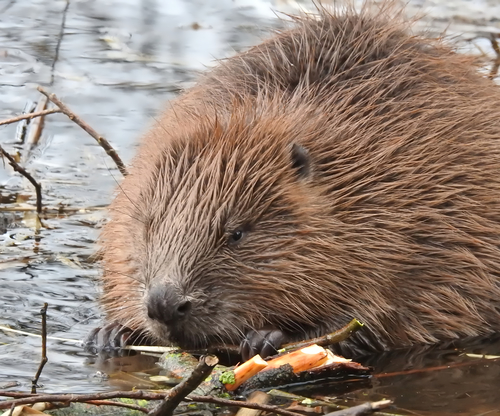
The largest rodent in Europe, it is probably the mammal most capable of single-handedly transforming its landscape, felling entire trees and building dams that alter the course of streams and small rivers. It was virtually extinct on the continent at the beginning of the 20th century, hunted until reduced to a handful of relict populations. Its return, thanks to sustained reintroductions in recent decades, is now one of the most cited cases of European wildlife recovery. Its activity as an ecosystem engineer benefits a huge number of other species, from amphibians to waterfowl, which colonise the wetlands its dams help to create.
A large rodent with a stocky body covered in dense, waterproof brown fur. Its broad, flat, scaly, paddle-shaped tail is very different from that of any other European mammal. It also has webbed hind feet.
It is not to be confused with the Muskrat or the Water Vole, both of which are much smaller and have rounded, not flattened, tails.
Large, webbed hind track, 12-15 cm long, often with tail drag marks between the tracks when moving on land. Droppings are rarely visible out of water, as the Eurasian Beaver usually defecates directly into it.
The most unmistakable tracks and signs of its presence are gnawed trunks and branches. These show very wide, parallel incisor marks, forming a characteristic hourglass shape at the base of the trunk. Other signs include dams of branches and mud impounding the watercourse, log slides leading to the water, and burrows dug into the bank or large branch constructions known as lodges.
Rivers, streams, lakes and wetlands with calm waters, surrounded by riparian vegetation, especially willow, poplar and birch, from lowlands to mid-mountain areas. Fragmentedly distributed across Europe and parts of Asia, with rapidly expanding populations thanks to active reintroductions in several countries.
Herbivorous, it feeds on bark, shoots and leaves of riparian trees in autumn and winter, and on herbaceous and aquatic plants in spring and summer.
It lives in stable family groups, formed by a pair and their young from different years, which cooperate in maintaining dams, canals, and burrows. It is mainly nocturnal and crepuscular, and actively transforms its environment by building dams that create new wetland areas.
Its populations have recovered remarkably in recent decades, thanks to reintroduction programmes and legal protection in numerous European countries. This follows its near-continental extinction at the start of the 20th century.
Conflict with agricultural and forestry activities due to felling trees and flooding land. Roadkill near watercourses. Occasional illegal persecution in areas of conflict with land management.
See all species accounts for rodents · Full species index
Mammaling is a free app for logging the mammals you find. You record a sighting in a moment — even if it's just a track — your life list grows, and the record becomes available to scientific and conservation projects.
It runs on your phone with nothing to install. If you like, it adds to your home screen like any other app.
Open Mammaling