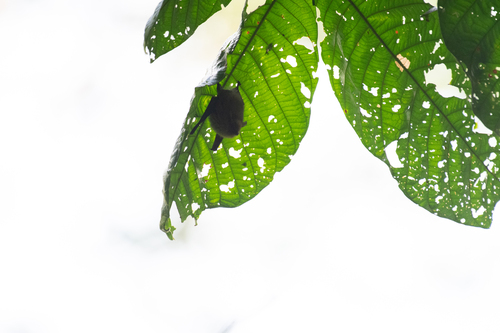
It is an insect-voring dwarf with a long fur and somewhat worn that gives it an unusual "dwarf" air among open-space dwarfs, and that probably fulfils a function of isolation in the wet jungle environments where it lives. It separated as a species owned by another very similar dwarf in South America after detailed studies at the end of the 20th century revealed consistent differences between Central American and South American populations. It lives in the wet tropical jungle of Central America and Northern South America, where it typically flies near the ground or just underneath the back, an unusual low-flight behavior between open-space insect-eating dwarfs. It is a species that is rarely studied and captured, reflecting both its discreet beha
Small-sized, medium-sized, long-shelled and somewhat brown-toned, relatively wide wings, and lack of nasal leaf. It differs from its nearest South American relative by cranial details and geographical distribution, with very little direct overlap between both species.
Tropical humid rainforest, from low lands to middle mountain heights.Distributed by Central America and Northern South America.
Insect-voring, it feeds on small insect captured in low flight, near the soil or underground.
Of nocturnal activity, it typically flies at low altitude, near the soil or the sotobosque, unlike other insecticide flies that hunt in more open space.
Their populations are generally considered stable in most of their distribution area.
Deforestation and fragmentation of wet rainforest by agricultural and livestock expansion.
See all species accounts for bats · Full species index
Mammaling is a free app for logging the mammals you find. You record a sighting in a moment — even if it's just a track — your life list grows, and the record becomes available to scientific and conservation projects.
It runs on your phone with nothing to install. If you like, it adds to your home screen like any other app.
Open Mammaling