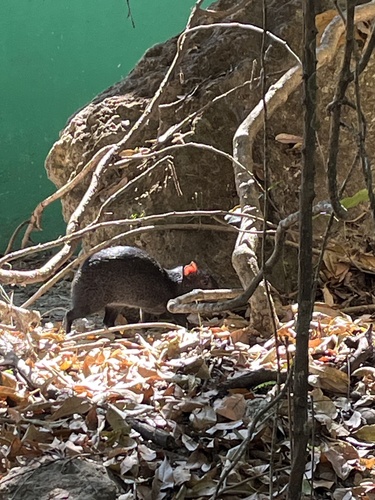
The Mexican Agouti is one of the few mammals able to crack with its teeth the extremely hard shells of certain tropical fruits that no other forest animal can open. By burying surplus food in caches across its home range to eat later, it forgets some of them, inadvertently sowing a significant portion of the forest it inhabits.
It runs and leaps with surprising agility for its size, supported by long, slender hind legs tipped with hooves instead of claws. This design is more akin to that of a small ungulate than a typical rodent.
The Mexican Agouti lives in the humid rainforests of southeastern Mexico. This area has lost most of its original forest cover in recent decades, with only scattered fragments remaining.
It is also a highly prized food source for local hunters. This adds hunting pressure to the already severe loss of its habitat.
A medium-large rodent with a compact body on long, slender legs. Its fur is dark brown to blackish, with orange reflections on the hindquarters, and its tail is very reduced, almost invisible. It differs from other large rodents in the region, such as the Tepezcuintle, by its darker, more uniform fur, lacking the latter's pale longitudinal spots, and by its longer, more slender legs.
Tracks show hooves rather than visible claws. They have four fore toes and three hind toes, and are 4-5 cm long. This makes them very distinct from the clawed tracks of other large rodents in the region.
Droppings are rounded, 1-1.5 cm long, left in small piles scattered along habitually used paths.
The Mexican Agouti buries caches of seeds and fruit in small, shallow holes scattered throughout its territory. This is one of its most characteristic tracks and signs. Also characteristic are remains of hard fruit gnawed with incisor marks so specific that no other mammal in the area can open the shell.
Lowland humid tropical forest with dense undergrowth.
Endemic to southeastern Mexico, in the states of Veracruz, northern Oaxaca, northwestern Chiapas, and western Tabasco, within an increasingly reduced and fragmented strip of forest.
Frugivorous and granivorous, the Mexican Agouti feeds on fallen fruit, seeds, and hard-shelled nuts that no other mammal in the area can open, as well as roots and occasional fungi, storing some surplus in buried caches for times of scarcity.
Solitary or in pairs, the Mexican Agouti is terrestrial and territorial. It plays a key role as a seed disperser, often forgetting to retrieve its caches.
It is primarily diurnal, although it can become more nocturnal in areas with high hunting pressure.
Its populations have suffered a reduction of over 80% in the last decade due to the accelerated conversion of jungle to agricultural and livestock land, combined with subsistence hunting. Confirmed local extinctions have occurred in much of its historical range.
Deforestation and forest fragmentation are driven by agricultural, livestock, and forestry plantation expansion. Other threats include subsistence and commercial hunting for its prized meat, and the increasing isolation of surviving populations.
See all species accounts for rodents · Full species index
Mammaling is a free app for logging the mammals you find. You record a sighting in a moment — even if it's just a track — your life list grows, and the record becomes available to scientific and conservation projects.
It runs on your phone with nothing to install. If you like, it adds to your home screen like any other app.
Open Mammaling