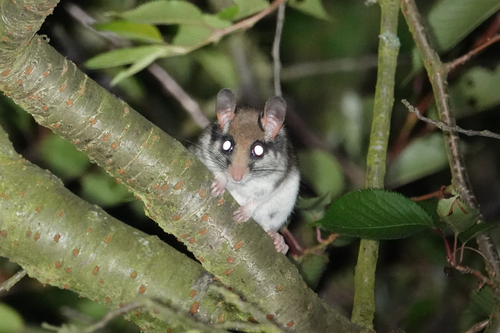
It has one of the most recognisable facial masks of any European mammal – a black stripe surrounding its eyes like a bandit mask – and a tail ending in a conspicuous tuft of hair.
The European Garden Dormouse is an agile climbing rodent that spends much of the year hibernating. However, its recent history greatly concerns specialists. It has disappeared from large areas of central and north-western
A small to medium-sized rodent with reddish-brown fur on its back and white on its belly. It has a striking black mask around its eyes that extends towards its ears, and a long tail ending in a bicoloured tuft of black and white hair. It differs from other European dormice by this distinctive facial mask, which is absent in the Grey Dormouse or in other species
Small track, 2-2.5 cm long, with 4 front toes and 5 hind toes, showing sharp claw marks typical of a good climber.
Small, elongated droppings, 0.8-1.2 cm long, containing remains of nuts, insects, and seeds. These are scattered under buildings, in tree hollows, or in rocky areas where the European Garden Dormouse shelters.
It leaves gnawed fruits and nuts with a clean bite pattern, and spherical nests of moss and leaves in crevices, tree hollows, or even attics of human buildings.
Mixed woodland, rocky areas, scrubland and, increasingly in some areas, rural and peri-urban environments with old buildings for shelter, from lowlands to mid-mountain areas.
It has a fragmented distribution across much of western and central Europe. Populations are more continuous in the south, but show very marked declines in the centre and north-west of the continent.
Omnivore: fruit, seed, nut and invertebrate, with a higher proportion of animal prey than other dormice, occasionally including eggs and small vertebrates.
Solitary and mainly nocturnal and arboreal, it hibernates for several months in temperate and cold climates, between late autumn and spring. It raises one or two litters a year of 4-6 young in populations in warmer areas.
The European Garden Dormouse has undergone a sharp decline in large areas of central and north-western Europe since the late 20th century, the causes of which are not yet fully understood. This has led to documented disappearances from entire regions where it was previously a common species. In southern Europe, populations appear more stable.
Loss of mature woodland and traditional buildings used as refuges, competition with other rodent species, and possible, still poorly understood effects related to changes in the availability of invertebrates on which it partially depends.
See all species accounts for rodents · Full species index
Mammaling is a free app for logging the mammals you find. You record a sighting in a moment — even if it's just a track — your life list grows, and the record becomes available to scientific and conservation projects.
It runs on your phone with nothing to install. If you like, it adds to your home screen like any other app.
Open Mammaling