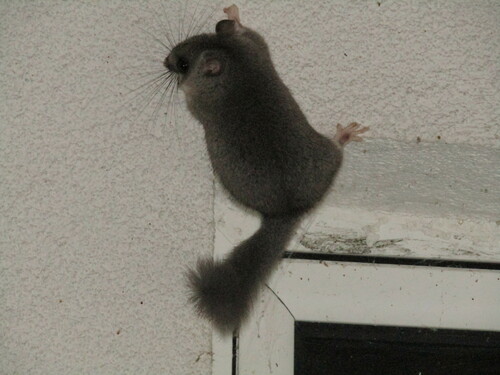
The European Fat Dormouse spends more time asleep than awake throughout its life. It can hibernate for up to seven or eight months a year, one of the longest torpor periods known among mammals. It shelters in an underground burrow where its metabolism slows to the point that its body temperature drops almost to that of its surroundings. Its common name refers to the Roman custom of deliberately fattening it in special enclosures to serve as a delicacy. This gastronomic tradition, documented since Antiquity, has persisted, albeit more marginally, in some areas of central Europe until recent times. Outside the hibernation season, the European Fat Dormouse is an exceptional nocturnal climber, capable of descending vertical trunks with the same ease with which it climbs.
The European Fat Dormouse is a medium-sized rodent for a dormouse, with the appearance of a small squirrel. It has uniform silver-grey fur on its back and whitish fur on its belly, large, prominent dark eyes, and a long, very bushy tail almost as long as its body. It differs from the Garden Dormouse, which is smaller and has a distinct black mask around its eyes. It also differs from the Red Squirrel, which is more reddish or brown in colouring and is diurnal, unlike the nocturnal European Fat Dormouse.
A small track, 2-2.5 cm long, with four fore toes and five hind toes, rarely visible except on very fine substrate near a burrow entrance. Small, elongated droppings 8-12 mm long, shaped like a curved grain of rice, deposited scattered on branches and in tree hollows used for shelter. The European Fat Dormouse occupies tree hollows, attics and
Mature deciduous woodland, especially with fruit and nut trees, dense undergrowth and available tree hollows, from lowlands to mid-mountain areas. Distributed across much of central and southern Europe and some areas of Asia Minor.
Omnivorous, primarily feeding on nuts, seeds, and fruit, supplemented with shoots, bark, and occasional invertebrates, accumulating body fat reserves in autumn before hibernation.
It hibernates for an exceptionally long period, up to seven or eight months depending on the region and autumn food availability. In years with a poor nut harvest, the European Fat Dormouse may not reproduce.
It is strictly nocturnal and a very good climber, living in loosely structured family groups outside of hibernation.
Populations are generally stable throughout most of its range, though with very marked annual fluctuations linked to mast availability. There are no signs of widespread decline.
Loss of mature woodland with tree hollows and nut-producing species. Additionally, in some areas, it is perceived as a pest in buildings close to woodland, leading to its direct elimination.
See all species accounts for rodents · Full species index
Mammaling is a free app for logging the mammals you find. You record a sighting in a moment — even if it's just a track — your life list grows, and the record becomes available to scientific and conservation projects.
It runs on your phone with nothing to install. If you like, it adds to your home screen like any other app.
Open Mammaling