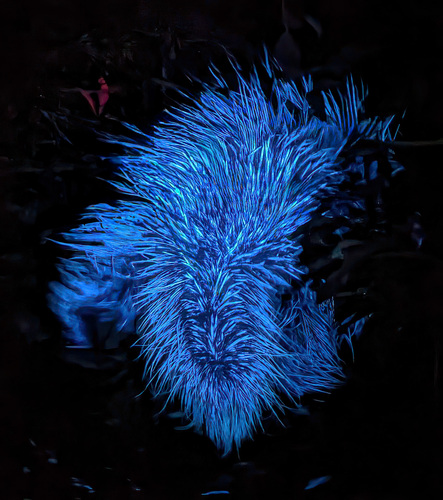
He carries over between 15,000 and 30,000 hollow and slightly covered pooys of a fatty substance that acts as a natural lubricant, facilitating that they claw easily into the skin of any predator rather temerary as to attack it closely, although, against popular belief, he can not shoot them at a distance. He lives in temperate and boreal forests of much of North America, where he spends much of his life slowly climbing between the branches in search of cortex and leaf, assisted by a long and curved clutches and a prensil tail partially adapted to grip. He is one of the few mammals able to digest large amounts of tree cortex during the winter, when he scares the rest of his vegetation, thanks to an intestinal bacteria specialized in decomposing
Large-sized rodent, robust body covered with long and rigid goats mixed with darker hair, small head in relation to the body, and thick tail also covered with short goats. It differs from any other American mammal by its so characteristic goats, a trait that does not share any other rodent in the region; its slow climbing is another sign of identity easy to recognize.
Fingerprint with 5 rear fingers and 4 front fingers, 6-7 cm, with a pattern of dragging and slow walking very different from that of other mammals of similar size, often with traction marks of the tail pounds visible next to the footprints. Extended capsule-shaped feces, 2-3 cm, with abundant visible wooden fiber, left in large amounts under trees used as a regular dining room. Leave very wide and parallel incisive marks on the cortex of trunks and branches, often completely depriving the cortex of an entire branch, and loose pounds attached to the cortex near rest areas.
A temperate and boreal forest of conifers and frondoses, from low lands to high mountain areas.Distributed by much of North America, from Alaska and Canada to northern Mexico.
Herbivorous, it feeds on shell, leaf and tenderness in summer, and mainly on tree shell in winter, when the rest of available vegetation is scarce.
Solitary out of the breeding season, of slow habits and climbers, he spends much of his time in the copes of the trees.It is mainly nighttime activity, and his main defense against predators are his feathers, which are clutched with ease to contact but that the animal cannot throw away.
Its populations are considered stable in the vast majority of its wide area of distribution, without signs of significant decline at species level.
It does not face significant threats at species level; locally suffers road crashes and occasional persecution for forest damage.
See all species accounts for rodents · Full species index
Mammaling is a free app for logging the mammals you find. You record a sighting in a moment — even if it's just a track — your life list grows, and the record becomes available to scientific and conservation projects.
It runs on your phone with nothing to install. If you like, it adds to your home screen like any other app.
Open Mammaling