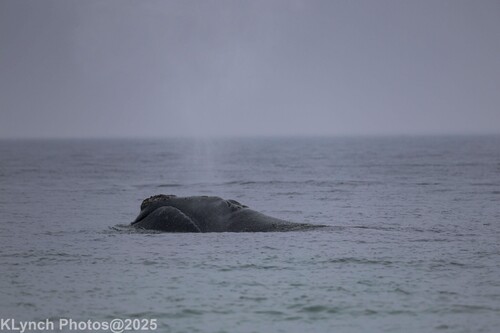
It is one of the most endangered whales on the planet. Its population today barely reaches a few hundred individuals, most of them individually identified and tracked by photo-catalogues that have been updated for decades. Its English name, "right whale" or "correct whale", comes precisely from having been considered for centuries the "right" prey for whalers. This was because it swims slowly, floats when it dies, and provides large quantities of oil and baleen. This past almost completely wiped out the North Atlantic Right Whale. Despite legal protection for decades, it has failed to recover, and today it dies more often from causes directly related to human activity than from natural causes.
The North Atlantic Right Whale is a large whale with a robust, dark body and no dorsal fin. Its head is covered in whitish callosities of thickened skin, arranged in a unique pattern on each individual, which allows individuals to be identified for life.
It differs from other large whales by the complete absence of a dorsal fin and by the characteristic callosities on its head.
It leaves no tracks on land; it is detected by a characteristic V-shaped blow, produced by two widely separated blowholes, visible from a distance in calm seas. The absence of a dorsal fin when surfacing to breathe is in itself a diagnostic feature, distinguishing it from almost any other large whale. Underwater, it produces low-frequency calls used for long-distance communication between dispersed individuals.
Coastal and continental shelf waters of the western North Atlantic. Feeding areas are in high latitudes off Canada and the northeastern United States, with breeding areas further south in shallow coastal waters.
It feeds on copepods and other tiny planktonic organisms, which it filters by swimming slowly with its mouth open through dense concentrations of prey near the surface or at mid-depth.
The North Atlantic Right Whale undertakes seasonal migrations between northern feeding grounds and more southerly calving grounds. However, changes in plankton distribution due to ocean warming have significantly altered its traditional routes in recent years.
Females give birth to a single young every 3-10 years. This unusually long reproductive interval greatly hinders population recovery.
The population, already considered severely depleted by centuries of historical hunting, has continued to decline in recent decades, primarily due to mortality caused by ship collisions and entanglement in fishing gear. Today, only a few hundred individuals remain, with fewer than a hundred breeding females.
Collisions with vessels in shipping lanes that cross their feeding and migration areas. Entanglement in pot and trap fishing gear. Alteration of their traditional feeding grounds due to climate change, which has shifted the distribution of their plankton prey.
See all species accounts for even-toed ungulates · Full species index
Mammaling is a free app for logging the mammals you find. You record a sighting in a moment — even if it's just a track — your life list grows, and the record becomes available to scientific and conservation projects.
It runs on your phone with nothing to install. If you like, it adds to your home screen like any other app.
Open Mammaling