It lives so strictly underground that it rarely pokes its head above the surface, moving through its own network of tunnels dug with its powerful forefeet and incisors, which grow continuously throughout its life to offset the wear of digging in sandy soil. Like all pocket gophers, its lips close behind the incisors, allowing it to gnaw and dig with a closed mouth without swallowing dirt—an adaptation as simple as it is effective. It inhabits the loose, sandy soils of the Chihuahuan Desert, a highly specific substrate on which it depends entirely to dig its tunnels, restricting its presence to very specific patches of the desert landscape. It spends almost its entire life alone, tolerating the company of another individual only during brief mating encounters.
A medium-sized rodent with a compact, cylindrical body adapted for life underground, light brown to sandy fur providing camouflage against its native substrate, greatly reduced eyes and ears, and robust forefeet with long digging claws. It differs from other pocket gophers in the region by its strict association with loose sandy soil and by cranial details; on the surface, it is virtually indistinguishable from other species in the genus without examining the skull.
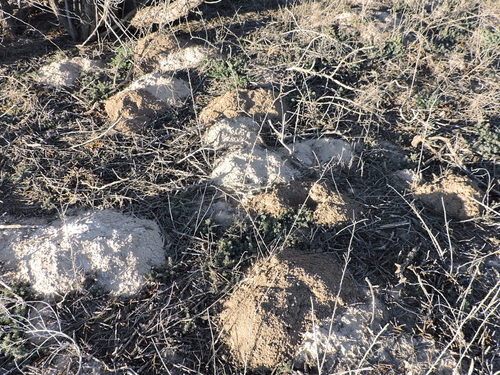
It leaves no recognisable footprints as it lives underground. Its presence is revealed by characteristic fan-shaped mounds of earth, 20-30 cm in diameter, with the tunnel entrance plugged with loose dirt from within—unlike the burrows of other rodents, which leave the opening exposed. Droppings are small and elongated, 1-1.5 cm long, and rarely visible as they remain inside the tunnel system. The mounds appear in lines that follow the course of the subterranean galleries, and its presence is also betrayed by plants that wither suddenly when their roots are severed from below.
Loose sandy soil in desert and arid scrub, from lowlands up to transition zones towards mountain desert. Distributed across a strip of the southwestern United States (Texas, New Mexico) and northern Mexico (Chihuahua), strictly associated with sandy substrate.
Herbivorous, feeding on roots, tubers and subterranean plant parts, as well as vegetation it drags into the tunnel from the surface near the entrance.
Strictly solitary and territorial outside the breeding season, it spends almost its entire life underground in its system of galleries. Its digging activity is continuous throughout the year, peaking after rains when the soil is softer.
Its populations are generally considered stable within its known range, although its distribution, restricted to loose sandy soil, leaves it vulnerable to any local disturbance of that substrate.
Disturbance of sandy soil through urban and agricultural development in parts of its range, alongside the species' own restriction to a very specific substrate type.
See all species accounts for rodents · Full species index
Mammaling is a free app for logging the mammals you find. You record a sighting in a moment — even if it's just a track — your life list grows, and the record becomes available to scientific and conservation projects.
It runs on your phone with nothing to install. If you like, it adds to your home screen like any other app.
Open Mammaling