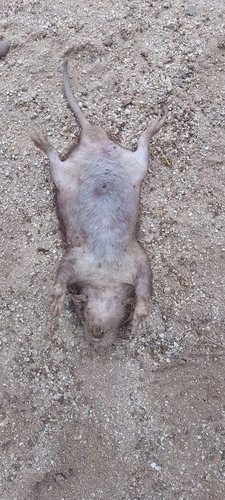
An endemic pocket gopher restricted to a very specific coastal strip along the Gulf of Mexico—an area so small that it could probably be crossed on foot in a single day, and which continues to shrink due to encroaching human activity on the last patches of sandy soil the species requires for digging. Like other pocket gophers, it spends almost its entire life underground, moving through a network of tunnels that it digs using its forefeet and incisors, which grow continuously to compensate for the wear of gnawing through soil and roots. Its name refers to the humid tropical climate of the coastal region of Veracruz where it lives, an environment vastly different from the arid deserts occupied by most of its pocket gopher relatives in northern Mexico and the southern United States. It is one of the Mexican mammals with the smallest home range in its entire genus.
A medium-sized rodent with a cylindrical, compact body adapted for subterranean life, dark brown fur, greatly reduced eyes and ears, and robust forefeet with long claws adapted for digging. It is distinguished from other pocket gophers in the region by its highly restricted distribution along the Veracruz coast and by cranial details; on the surface, it is virtually indistinguishable from other species of the genus without cranial examination.
It leaves no recognisable track due to its underground lifestyle; its presence is betrayed by fan-shaped mounds of earth, 15-25 cm in diameter, with the tunnel entrance plugged with loose dirt from the inside. Droppings are small and elongated, 1-1.5 cm, but rarely visible as they remain inside the tunnel system. The mounds appear in lines following the layout of the subterranean galleries, and its presence is also revealed by plants that wither suddenly when their roots are cut from below.
Loose sandy soil in tropical coastal areas, in lowlands near the shoreline. Endemic to a very small strip of the central coast of Veracruz state, in eastern Mexico, with no natural presence outside this area.
Herbivorous, feeding on roots, tubers and subterranean plant parts, as well as vegetation dragged into the tunnel from the surface near the entrance.
Strictly solitary and territorial outside the breeding season, it spends almost its entire life underground in its system of galleries, like other pocket gophers.
Its populations are considered to be in decline due to the ongoing loss of the coastal sandy soil on which it depends, increasingly altered by urban and agricultural development in the Veracruz coastal area.
Urban and agricultural development over the coastal sandy soil on which it depends, and the species' extreme geographical restriction to a very narrow strip of coastline.
See all species accounts for rodents · Full species index
Mammaling is a free app for logging the mammals you find. You record a sighting in a moment — even if it's just a track — your life list grows, and the record becomes available to scientific and conservation projects.
It runs on your phone with nothing to install. If you like, it adds to your home screen like any other app.
Open Mammaling