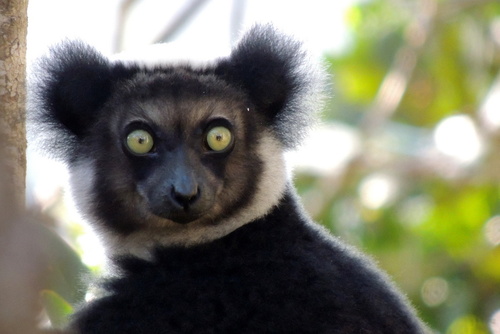
Its call is a prolonged, modulated howl that can last over two minutes and be heard several kilometres through the forest. It is one of Madagascar's most characteristic sounds, so recognisable it has been compared to a Humpback Whale's song transposed to the jungle.
It is the largest living lemur. It completely lacks the long tail characteristic of almost all its relatives, a trait that makes it appear, at first glance, more like a small bear than a primate.
Its situation is now so critical that specialists consider it one of the primates at greatest short-term risk of extinction on the entire planet. Its disappearance would also leave the seeds of numerous Malagasy forest trees, which depend on it, undispersed.
The largest of living lemurs, with a robust body, black and white fur in a highly variable pattern depending on the population, rounded ears covered in hair and, unlike almost all other lemurs, an extremely short tail, barely a stump. It is unmistakable within its range due to its combination of large size and almost absent tail, and especially its characteristic song, distinct from any other primate.
Fore and hind tracks have 5 toes. The hind track is 8-11 cm long, with the first toe widely separated and opposable. Droppings are irregular, with abundant plant fibre, and left scattered under feeding trees. The most unmistakable sign of Indri presence is the group song. This is a prolonged, modulated howl, emitted several times a day. It marks territory against neighbouring groups and is audible over three kilometres in favourable conditions.
Lowland humid tropical forest, generally between 200 and 1600 m altitude. Endemic to a very small area in northeast Madagascar, with one of the smallest and most fragmented distributions among all the world's great primates.
Mainly folivorous, the Indri feeds on young leaves, supplemented by fruit, flowers, and seeds depending on seasonal availability. It moves carefully through the tree canopy to access the tenderest parts of the vegetation.
Indri live in small, monogamous family groups, defending a fixed territory through group singing without direct physical confrontation with neighbouring groups. The female raises a single young every 2-3 years, one of the slowest reproductive rates among lemurs. This greatly hinders the recovery of Indri populations.
Its population continues in sharp decline due to the loss and fragmentation of the forest it inhabits. Its distribution is already reduced to a small number of isolated forest fragments. This has led specialists to rank it among the primates at greatest immediate risk of extinction on the planet.
Deforestation due to logging and slash-and-burn agriculture, habitat fragmentation impeding genetic exchange between isolated groups, local poaching for consumption, and its extremely slow reproductive rate, severely limiting the species' recovery capacity.
See all species accounts for primates · Full species index
Mammaling is a free app for logging the mammals you find. You record a sighting in a moment — even if it's just a track — your life list grows, and the record becomes available to scientific and conservation projects.
It runs on your phone with nothing to install. If you like, it adds to your home screen like any other app.
Open Mammaling