On the ground, Verreaux's Sifaka moves with one of the most peculiar and recognisable gaits in the animal kingdom. Unable to walk on all fours because its hind legs are much longer than its forelimbs, it crosses forest clearings with a series of sideways leaps, arms held high. This dance has brought it worldwide fame in nature documentaries. Among the trees, however, it is an extraordinary jumper, capable of propelling itself from trunk to trunk with its powerful hind legs and landing precisely even on very thin branches. It lives exclusively in the dry, spiny forests of southern Madagascar, an increasingly shrinking habitat which it shares with some of the planet's most unique plant landscapes.
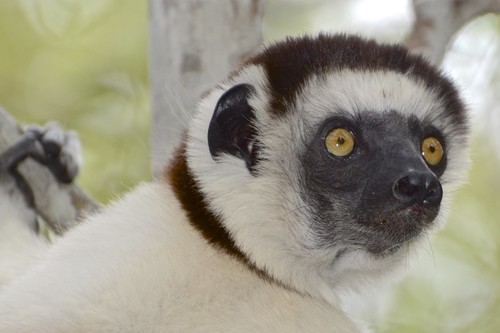
A medium-sized primate. Its fur is white, with a reddish-brown cap and patches on the crown and limbs, varying by population. It has a black naked face. Its legs are much longer and more muscular than its arms, adapted for vertical leaping between tree trunks.
It differs from true lemurs in its way of moving on the ground: by bipedal sideways leaps instead of walking on all fours. This is a unique behaviour among Madagascar's primates.
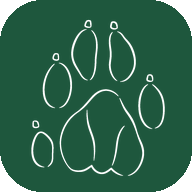
Hind track with 5 toes, the first very separated and opposable. It is much larger than the fore track, 7-9 cm long, reflecting powerful hind legs adapted for jumping.
Irregular droppings with plant fibre and seeds, left scattered under feeding trees.
On the ground, Verreaux's Sifaka can be recognised by bipedal landing marks after a series of lateral leaps, which are very distinct from any quadrupedal track. Its arboreal presence is revealed by branches bent by the impulse of a jump and by characteristic alarm grunts and whistles.
Dry deciduous forest, spiny forest and xerophytic scrub, from lowlands to mid-mountain areas. Endemic to southern and south-western Madagascar, with a fragmented and rapidly declining distribution, with no natural presence outside the island.
Herbivorous, it feeds on leaves, flowers, fruits and bark depending on seasonal availability in the dry forest. It can exploit plants with chemical defences that other herbivores avoid.
Verreaux's Sifaka lives in small family groups with a female-led hierarchy, defending a territory marked with glandular secretions on tree trunks and branches. Reproduction is highly concentrated seasonally, with synchronised births just before the rainy season, when food availability is highest.
The Verreaux's Sifaka population has undergone a very sharp and rapid decline in recent decades. This is due to the loss of the dry forest it depends on, one of Madagascar's most threatened habitats. Consequently, the species is now ranked among primates at highest risk of short-term extinction.
Deforestation of dry forest by logging, charcoal production, and agricultural and livestock expansion; local hunting for consumption; and extreme habitat fragmentation, isolating surviving groups from one another.
See all species accounts for primates · Full species index
Mammaling is a free app for logging the mammals you find. You record a sighting in a moment — even if it's just a track — your life list grows, and the record becomes available to scientific and conservation projects.
It runs on your phone with nothing to install. If you like, it adds to your home screen like any other app.
Open Mammaling