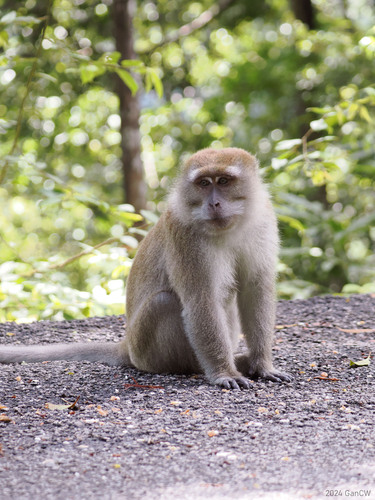
The Long-tailed Macaque's name is only partly accurate: in addition to crabs, it forages for molluscs, fruit, and insects with remarkable manual dexterity in the mangrove areas where it lives. It is one of the most widespread primates in Southeast Asia, capable of adapting to remote mangroves as well as to crowded temples and cities.
In recent years, it has gone from being a species with no apparent problems to being a focus of conservation concern. This change followed the uncovering
A medium-sized primate with grey-brown fur, a pinkish or greyish face, and hair tufts swept back on the crown. Its tail is very long, almost always longer than the body. It can be confused with other Asian macaques where their ranges overlap, but the disproportionately long tail is the most reliable feature to distinguish the Long-tailed Macaque.
Tracks show 5 toes on fore and hind feet, almost human-like in miniature, with hind tracks 7-9 cm long. Irregular droppings contain abundant seed and fibre remains, scattered under feeding trees and along the shoreline in coastal populations. Broken crab and mollusc shells are commonly found near water, as are shaken branches and alarm calls when human presence is detected.
Tropical forest, coastal mangrove and riparian areas, with high tolerance for altered and urban environments. Distributed across mainland and island Southeast Asia, from southern Myanmar to the Philippines and Indonesia.
Opportunistic omnivore: fruit, seeds, leaves, invertebrates, crabs and molluscs in coastal areas, and frequently human-derived food in urbanised areas and temples.
Highly social, the Long-tailed Macaque lives in groups of several dozen individuals, with related females forming the stable core and males emigrating between groups upon reaching maturity. In many populations, it coexists closely with humans, which often leads to conflicts.
The Long-tailed Macaque has experienced a sharp increase in capture pressure over the last decade to supply breeding farms for biomedical research. Massive extractions from the wild, documented in Southeast Asia, prompted a re-evaluation of its status in 2022, which was confirmed after a subsequent review.
Massive capture for the laboratory animal trade, which includes laundering wild specimens through breeding farms. Other threats are loss of coastal and mangrove habitat, and persecution due to conflict with crops and urban areas.
See all species accounts for primates · Full species index
Mammaling is a free app for logging the mammals you find. You record a sighting in a moment — even if it's just a track — your life list grows, and the record becomes available to scientific and conservation projects.
It runs on your phone with nothing to install. If you like, it adds to your home screen like any other app.
Open Mammaling