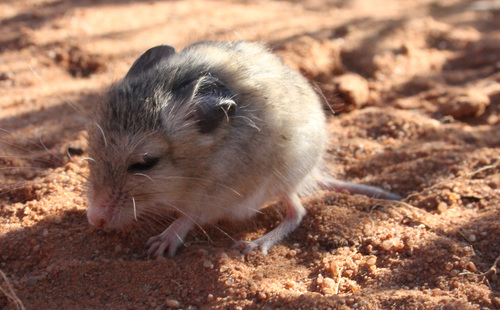
With ears disproportionately large for its size, this rodent of the arid South African interior uses them to dissipate excess heat during the day while resting curled up in a deep burrow it excavates itself. It is a solitary and elusive animal about which relatively little is known, despite being well documented from a physiological standpoint.
A small rodent with very large ears relative to its body, and slightly elongated hind feet. The coat is greyish-brown to sandy, with a white belly. It differs from other small rodents in the region by its disproportionately large ears.
Small tracks and signs with slightly elongated hind foot marks. It excavates deep burrows in sandy soil, sealing the entrances during the day.
Arid and semi-desert scrub in Angola, Botswana, Namibia and South Africa.
Seeds and insects.
Solitary and presumably asocial, with nocturnal activity. It uses its large ears to regulate body temperature in its arid environment.
The species maintains a large and stable population across most of its range, with no evidence of a widespread decline.
No widespread threats identified.
See all species accounts for rodents · Full species index
Mammaling is a free app for logging the mammals you find. You record a sighting in a moment — even if it's just a track — your life list grows, and the record becomes available to scientific and conservation projects.
It runs on your phone with nothing to install. If you like, it adds to your home screen like any other app.
Open Mammaling