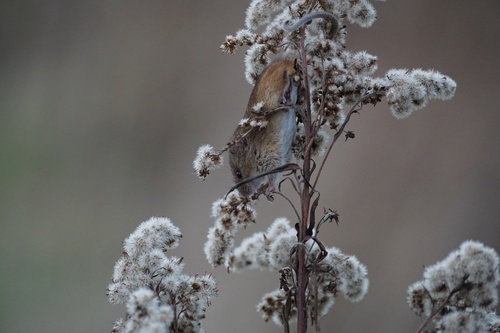
The Eurasian Harvest Mouse is the smallest rodent in Europe and one of the lightest mammals on the continent. It is so tiny that it can climb a wheat stalk without barely bending it. This is thanks to a prehensile tail capable of wrapping around vegetation like a fifth limb, a trait no other European rodent has developed with such precision.
It builds one of the most elaborate nests of any mammal its size: a ball woven from intertwined live grass blades, suspended between several stalks halfway above the ground. The nest is so well constructed that it can be mistaken for a bird's nest at first glance.
It lives in a world almost invisible to the human eye, among the stalks of cereal crops, reedbeds, and tall grasslands, where it spends most of its life barely touching the ground.
The Eurasian Harvest Mouse is the smallest rodent in Europe. Adults rarely weigh more than ten grams. It has reddish-brown fur on its back and white on its belly, a short, blunt snout, and a long, prehensile tail capable of wrapping around plant stems. This is a unique feature among European rodents of its size.
It differs from other small mice by its extremely small size and its prehensile tail, which no other European murid has so well developed.
Tracks are tiny, barely 1 cm, and rarely visible. This is due to the animal's light weight and its almost entirely arboreal life among vegetation. Tiny droppings, 2-3 mm long, are left scattered among the stems of dense vegetation where it lives. The most characteristic sign of its presence is the breeding nest. This is a ball woven from interwoven live grass blades, 6-10 cm in diameter, suspended among several stems 30-100 cm above the ground. It is very distinct from any burrow or ground-level nest of other small rodents, and can be confused at first glance with a small bird's nest.
Tall grassland, reedbeds, hedges, and cereal field edges. It strongly depends on dense, tall vegetation, which allows it to move without descending to the ground. Found from lowlands to low mountain areas. Distributed throughout much of Europe and Asia, from the United Kingdom to eastern Russia and Japan.
Omnivorous, it feeds on grass seeds, cereal grains, small fruits and invertebrates, collected mainly by climbing among the stems of the vegetation it lives in.
Variably active throughout the day and night, it lives almost entirely arboreal among tall vegetation stems, rarely descending to the ground. It builds several nests throughout the season; the breeding nest is especially elaborate. It has a high reproductive capacity, producing several litters per year in favourable conditions.
Populations are generally stable across most of its range, although in some regions of highly intensified agriculture, a local decline has been documented, linked to the loss of hedges and field margins with tall vegetation.
Agricultural intensification, eliminating hedges, field margins, and crop edges with tall vegetation; mechanised mowing during the breeding season, which can destroy nests with young inside; and the use of rodenticides in the agricultural environment.
See all species accounts for rodents · Full species index
Mammaling is a free app for logging the mammals you find. You record a sighting in a moment — even if it's just a track — your life list grows, and the record becomes available to scientific and conservation projects.
It runs on your phone with nothing to install. If you like, it adds to your home screen like any other app.
Open Mammaling