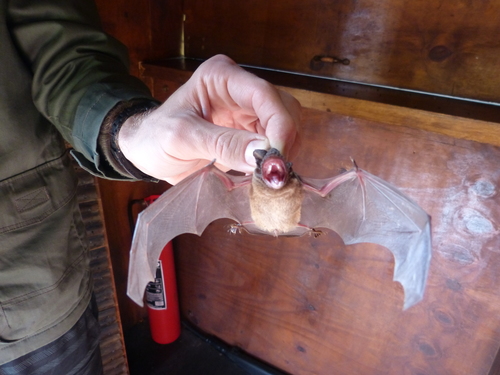
One of Africa's smallest and most common bats, the Little Free-tailed Bat uses a low-frequency, high-intensity echolocation call. This is adapted for detecting prey at long range in the open spaces where it hunts, as low frequencies attenuate less over distance than higher ones. It forms colonies in tree hollows and beneath roof tiles, where its tiny size makes its presence easy to overlook.
One of the smallest bats in its genus, with a total length of just 5.4-10.2 cm. Short fur, dark brownish on the back and paler on the belly. Long tail that projects clearly beyond the interfemoral membrane. Distinguished from other Mops species in the region by its very small size.
Tracks and signs include relatively low-frequency, high-intensity calls, a strategy favouring long-range prey detection in open spaces because low frequencies attenuate less over distance; no specific peak energy frequency is given here as none has been published with sufficient reliability for this species. Roosts provide another sign: it uses tree hollows, rock crevices and spaces beneath roof tiles, leaving dark, elongated guano accumulated beneath the perch.
Savannah, open woodland and urbanised areas from sea level to mountainous regions, across a broad mosaic of sub-Saharan Africa and nearby islands.
Nocturnal flying insects, caught on the wing high in open spaces.
Forms colonies in tree hollows and beneath roof tiles, with breeding documented in studied populations in southern Africa.
Maintains a large, stable population across most of its range, with no evidence of widespread decline.
No widespread threats identified.
See all species accounts for bats · Full species index
Mammaling is a free app for logging the mammals you find. You record a sighting in a moment — even if it's just a track — your life list grows, and the record becomes available to scientific and conservation projects.
It runs on your phone with nothing to install. If you like, it adds to your home screen like any other app.
Open Mammaling