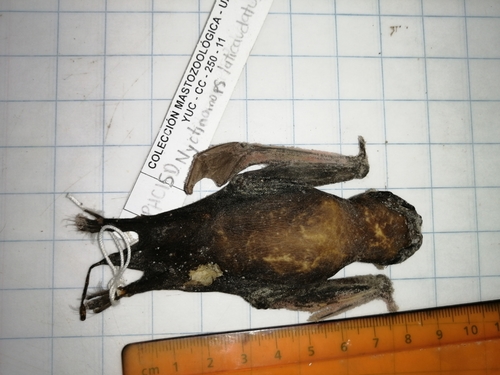
This Broad-eared Free-tailed Bat has an unusual acoustic trick: it alternates several distinct frequencies within the same flight sequence, as if changing radio channels while hunting. It lives from northern Mexico to central South America, with widely dispersed populations ranging from the Caribbean to Argentina. Like others in its genus, much of its tail protrudes from the membrane between its hind feet. Its pointed, slightly upturned snout, distinct from that of its relatives, is one of the few external features that help differentiate it in the hand.
Dark chocolate brown fur with a paler belly, translucent and hairless wings, and a pointed snout with a slightly upturned tip. It is confused with other Nyctinomops species in its range, particularly N. aurispinosus. The lower jaw, longer and narrower than is typical for free-tailed bats, is one of the few distinguishing features. However, certain identification usually requires cranial examination.
Variable peak energy frequency, with pulses that can alternate between three distinct frequencies within the same sequence, around 26-32 kHz. This alternation pattern is characteristic of the genus Nyctinomops. The pulse is quasi-constant with downward modulation, appearing on the sonogram as horizontal segments at different heights within the same pass, rather than a single continuous line.
The Broad-eared Free-tailed Bat shares this frequency alternation with other Nyctinomops species in its range, particularly N. aurispinosus, with which it can overlap in frequency. Reliable separation by sonogram alone is not always possible without capture or ecological context. It roosts in crevices of buildings, bridges, and caves, leaving accumulations of dark
Arid and semi-arid lowland areas, with caves, crevices, and buildings as roosts, from northern Mexico to central South America, including the Caribbean.
Flying insects, captured in high, fast flight, like other free-tailed bats.
It forms colonies in caves, cracks in buildings and bridges. It flies high and fast in open country hunting insects.
The Broad-eared Free-tailed Bat is widely distributed with a stable population across most of its extensive American range.
Loss of roosts in caves and old buildings, and use of pesticides which reduce insect availability in some areas of its range.
See all species accounts for bats · Full species index
Mammaling is a free app for logging the mammals you find. You record a sighting in a moment — even if it's just a track — your life list grows, and the record becomes available to scientific and conservation projects.
It runs on your phone with nothing to install. If you like, it adds to your home screen like any other app.
Open Mammaling