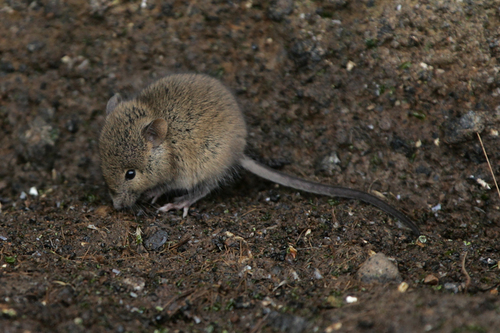
Few mammals have travelled so widely without moving under their own power. Originating in Central Asia and the Indian subcontinent, the House Mouse has colonised virtually the entire planet aboard human ships, trains, and aircraft, reaching remote islands and scientific bases in Antarctica. It is also one of the most studied mammals in laboratories worldwide, forming the basis of a huge part of what science now knows about genetics and medicine. However, on islands where it has arrived without natural predators, it has become a serious threat to seabirds that did not evolve to defend themselves against it.
Small rodent with uniform greyish-brown fur, a somewhat paler belly, and large, rounded ears. Its tail is as long as or longer than its body, covered in visible scales with sparse hair. The House Mouse is confused with field mice of the genus Apodemus, which have proportionally larger eyes and ears and are usually somewhat larger. The House Mouse has a characteristic strong musky odour, especially the male.
Tiny track, 1-1.5 cm, with 4 fore toes and 5 hind toes, rarely visible except in dust or flour. Droppings are elongated, rice-grain shaped, 3-6 mm long, with pointed ends. They are left in large quantities and scattered where the House Mouse feeds, unlike rats, which usually concentrate them in latrines. Fine, clean gnaw marks on packaging, cables, and wood, together with a persistent musky odour in nesting areas, are unmistakable signs of its presence indoors.
Extremely adaptable, from open country and scrub to, primarily, the interiors of human buildings (houses, warehouses, barns). Native to Central Asia and the Indian subcontinent, the House Mouse is now distributed almost worldwide as a commensal species involuntarily transported by humans, including remote oceanic islands and Antarctic bases.
An opportunistic omnivore, it eats seed, grain, fruit, insects, and practically any available human food remains.
Very prolific, with several litters of 4-8 young per year. The House Mouse can reproduce year-round indoors in stable climates. It lives in colonies with dominance hierarchies among males.
Populations associated with human constructions do not hibernate or migrate. However, some wild populations in temperate climates reduce their activity in winter.
It maintains extremely numerous and expanding populations almost worldwide due to its close association with humans, with no sign of decline.
The House Mouse faces no relevant threats. On the contrary, in many oceanic islands it poses a serious risk to seabirds and other native species by preying on eggs and chicks.
See all species accounts for rodents · Full species index
Mammaling is a free app for logging the mammals you find. You record a sighting in a moment — even if it's just a track — your life list grows, and the record becomes available to scientific and conservation projects.
It runs on your phone with nothing to install. If you like, it adds to your home screen like any other app.
Open Mammaling