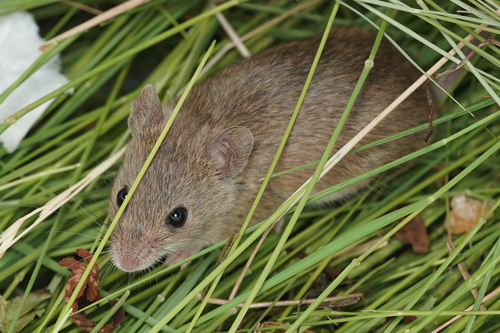
The Western Mediterranean Mouse is a wild mouse that, despite its strong superficial resemblance to the House Mouse, rarely interbreeds with it in practice. Where both species coexist, the Western Mediterranean Mouse dominates natural and agricultural environments, while the House Mouse is found almost exclusively within human constructions. This habitat partitioning is so marked that it has made the pair a classic model for studying competitive exclusion between closely related species. It is also one of the most widely used model organisms in evolutionary genetics. Despite its external similarity to the Laboratory Mouse, its enormous genetic divergence makes it a very valuable tool for studying the evolution of the muridae genome.
A small rodent, very similar to the House Mouse in size and general shape. Its fur is greyish-brown on the back and white on the belly, with the contrast between these two colours somewhat more marked than in the House Mouse. It differs from the House Mouse by almost always inhabiting open natural and agricultural environments rather than human constructions, and by having a less intense body odour. Reliable identification in hand often requires cranial or genetic details.
A tiny track, barely 1-1.5 cm long, with four front toes and five hind toes. It is practically identical to that of the House Mouse, making tracks and signs alone unreliable for distinguishing between the two species. Small, elongated droppings, 4-6 mm long, are left scattered along paths through cultivated land and scrub. The Western Mediterranean Mouse builds shallow burrows with several entrances in field margins, banks, and crop edges. These often contain stores of cereal seeds, a behaviour more pronounced than in the House Mouse.
The Western Mediterranean Mouse inhabits agricultural areas, Mediterranean scrubland, field margins and banks. It clearly prefers open natural or cultivated environments to the interior of human constructions, occurring from sea level to mid-mountain areas. It is distributed throughout southwest Europe and northwest Africa, within the Western Mediterranean region.
Omnivorous, predominantly feeding on grass seeds and cereal grains, supplemented with invertebrates and tender shoots depending on seasonal availability.
Solitary or in small, loosely structured groups, the Western Mediterranean Mouse is mainly nocturnal, with a high reproductive capacity and several litters per year in favourable conditions. In areas where it coexists with the House Mouse, both species maintain very marked habitat segregation, with the Western Mediterranean Mouse dominating open agricultural and natural environments.
The Western Mediterranean Mouse maintains large and stable populations throughout most of its range, with no signs of widespread decline, favoured by its good adaptation to Mediterranean agricultural landscapes.
Agricultural intensification, eliminating field margins and banks with natural vegetation, and the use of rodenticides in some cultivated areas.
See all species accounts for rodents · Full species index
Mammaling is a free app for logging the mammals you find. You record a sighting in a moment — even if it's just a track — your life list grows, and the record becomes available to scientific and conservation projects.
It runs on your phone with nothing to install. If you like, it adds to your home screen like any other app.
Open Mammaling