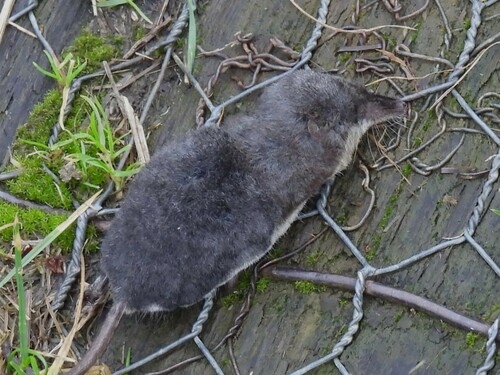
The Eurasian Water Shrew is one of the few mammals in the world with venomous saliva. This neurotoxin, produced in submandibular glands, is injected when the shrew bites. It allows the shrew to immobilise prey much larger than itself, such as frogs or small fish – an unusual feat for an animal weighing only a few grams.
The Eurasian Water Shrew swims and dives adeptly in cold-water streams and ponds. This is thanks to a fringe of stiff hairs on its feet and tail, which act almost like oars. These hairs also trap a thin layer of air, giving its submerged fur a characteristic silvery sheen.
Despite spending much of its time in water, the Eurasian Water Shrew, like other shrews, has an accelerated metabolism. It needs to eat constantly and barely survives a few hours without food.
The Eurasian Water Shrew is a tiny, shrew-like mammal. Its velvety black fur on the back contrasts with a white or greyish belly. It has a long, mobile snout and a characteristic fringe of stiff, silvery hairs on the edge of its feet and under its tail, adapted for swimming. It differs from other European shrews due to the marked contrast between its black back and pale belly. It is also distinguished by its almost exclusive association with watercourses, a habitat that other shrews of its size do not frequent with the same intensity.
Tiny track, only 1-1.5 cm long, visible mainly in fine mud beside water, with marks of the hairy fringe on the feet, distinguishing it from a terrestrial shrew's track. Tiny, dark droppings, a few millimetres long, with remains of aquatic insect chitin visible under a magnifying glass, deposited scattered along the banks. It builds short tunnels excavated in the bank with an
Banks of streams, fast-flowing rivers, ponds, and wetlands with riparian vegetation, from lowlands to mid-mountain areas. Distributed across much of Europe and northern Asia, its presence is strictly tied to the proximity of clean, well-oxygenated water.
Carnivorous, it feeds on aquatic invertebrates, small fish, amphibians and tadpoles, captured through short, active dives, often immobilised with the genus's characteristic venomous bite.
Solitary and territorial, the Eurasian Water Shrew is active in short bursts throughout the day and night. Its very high metabolism requires it to feed extremely frequently. It is an excellent swimmer and diver, despite lacking the pronounced anatomical adaptations of larger semi-aquatic mammals.
It maintains generally stable populations throughout most of its range where clean, well-oxygenated water persists. However, locally it can be sensitive to pollution of the watercourses on which it is entirely dependent.
Pollution and eutrophication of watercourses, reducing the availability of aquatic invertebrates; channelisation and loss of natural riparian vegetation; and predation by introduced species such as the American Mink in some areas.
See all species accounts for hedgehogs and shrews · Full species index
Mammaling is a free app for logging the mammals you find. You record a sighting in a moment — even if it's just a track — your life list grows, and the record becomes available to scientific and conservation projects.
It runs on your phone with nothing to install. If you like, it adds to your home screen like any other app.
Open Mammaling