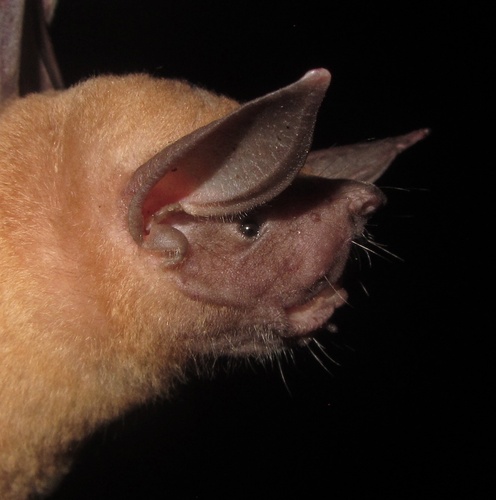
The Lesser Bulldog Bat patrols at night the surface of rivers, lagoons, and estuaries in Central America and much of South America. It uses echolocation to detect ripples left by fish or insects breaking the water's surface. Its hind feet, large and armed with curved claws, are adapted to snatch prey in flight without landing. Although its larger relative, the Greater Bulldog Bat, is better known, this species is much more common and feeds mainly on aquatic insects, only occasionally taking fish.
Its fur ranges from reddish-brown to orange. It has disproportionately large legs and feet with curved claws, and a bulging upper lip (hence the name "bulldog"). It differs from the Greater Fishing Bat (Noctilio leporinus) by its distinctly smaller size and by flying closer to the water's surface. It shares habitat with other insectivorous bats, from which it is distinguished by its
Peak energy frequency between 72 and 75 kHz in the constant frequency part of the pulse. It is a mixed CF-FM pulse: an initial flat, prolonged section followed by a downward sweep to around 57 kHz. On the detector screen, it appears as a horizontal line followed by a short downward hook. The pulses, 6-11 ms long, are emitted in pairs at a rate of 7-10 pairs per second, shortening and losing the constant frequency part when pursuing prey at close range.
Due to its very high frequency, it is difficult to confuse it with most terrestrial insectivorous bats in the area. However, it is not always possible to reliably distinguish it from other species that also hunt over water based solely on the sonogram, without observing its low-level flight. Beneath its roosts (tree hollows, culverts, bridges), dark, crumbly guano accumulates, containing insect chitin remains and a characteristic fishy smell. The Lesser Bulldog Bat usually emerges shortly after sunset to begin hunting.
Areas near rivers, lagoons, and low-lying estuaries, from Central America to northern and central South America, generally below 500 m altitude.
Primarily aquatic insects and those from riparian vegetation, caught in flight or on the water surface; occasionally small fish.
The Lesser Bulldog Bat forms variable-sized colonies in tree hollows, bridges or culverts near water. It hunts in low, skimming flights over the surface, detecting prey by sonar and the ripples they produce.
The Lesser Bulldog Bat is considered stable and widely distributed throughout Central and South America, with no signs of significant decline in most of its range.
Pollution and degradation of watercourses and riparian zones reduce the availability of aquatic insects and suitable refuges.
See all species accounts for bats · Full species index
Mammaling is a free app for logging the mammals you find. You record a sighting in a moment — even if it's just a track — your life list grows, and the record becomes available to scientific and conservation projects.
It runs on your phone with nothing to install. If you like, it adds to your home screen like any other app.
Open Mammaling