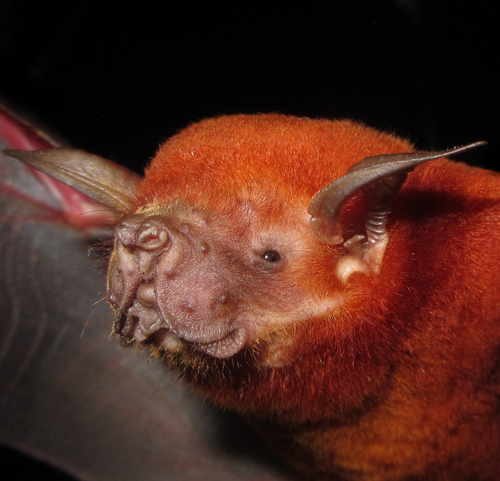
The Greater Bulldog Bat is the only American bat specialised in fishing. It flies low over rivers, coastal lagoons, and mangroves. As soon as its sonar detects the ripple left by a fish near the surface, it plunges the long, curved claws of its hind feet into the water to scoop it out. Afterwards, it perches to eat and clean itself, leaving behind the characteristic fishy smell that permeates its roosts. It lives from central Mexico to northern Argentina, always associated with freshwater or coastal bodies of water.
Large for an American bat, the Greater Bulldog Bat has orange-brown to reddish fur, disproportionately large hind legs and feet armed with long, curved claws, and a bulging upper lip. It differs from the Lesser Bulldog Bat (Noctilio albiventris) by its clearly larger size and by actively hunting fish on the surface instead of flying so close to the water. Its fishy smell and enormous feet distinguish it from any other insectivorous bat in the region.
Peak energy frequency is between 53 and 56 kHz in the constant frequency part of the pulse, with a final frequency-modulated section up to 26 kHz wide. On the detector, this appears as a prolonged horizontal line followed by a downward sweep, longer than that of the Lesser Fishing Bat.
Pulses are grouped in bursts of 2 to 4 while the Greater Bulldog Bat flies 20-50 cm above the water surface. They shorten and accelerate when a prey item is located near the surface. Its frequency overlaps with that of other medium-sized species in the area, so reliable identification by sonogram requires context. Its low, repetitive flight over open water is a characteristic no other bat in the region maintains so consistently.
Beneath its roosts (large tree hollows, caves, bridges), dark guano stains accumulate alongside fish scales and a strong fishy odour. The Greater Bulldog Bat usually emerges shortly after sunset to begin fishing.
Rivers, lagoons, mangroves, and lowland coastal areas, from central Mexico to northern Argentina, almost always near open water.
Small fish caught on the water surface, supplemented with aquatic insects, especially when fishing is scarce.
Forms colonies in tree hollows, caves or buildings near water. It is a specialist hunter that locates its prey by sonar, stopping to groom after each capture.
It is stable and widely distributed across Central and South America. There is no evidence of widespread decline across its range.
Pollution of rivers and coastal areas, and destruction of mangroves and riparian forests, which reduce their fishing grounds.
See all species accounts for bats · Full species index
Mammaling is a free app for logging the mammals you find. You record a sighting in a moment — even if it's just a track — your life list grows, and the record becomes available to scientific and conservation projects.
It runs on your phone with nothing to install. If you like, it adds to your home screen like any other app.
Open Mammaling