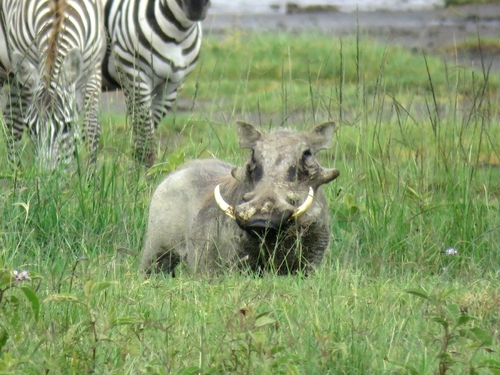
With those facial warts and upward-curving tusks, the Common Warthog is no beauty, but it is one of the most photographed animals of the African savanna. This is especially true when it flees with its tail stiff like an antenna.
It is a wild relative of the domestic pig, adapted to kneeling on calluses on its knees to dig for roots.
It has a curious habit: it does not dig its own burrows. Instead, it occupies those abandoned by aardvarks. It always enters backwards, ready to emerge defending itself if something surprises it inside.
A medium-sized suid, the Common Warthog has grey-brown skin, almost hairless except for a dorsal mane. Its large head bears two pairs of prominent facial warts (larger in males) and visible curved tusks. When running, it raises its tail vertically like an antenna, a very characteristic feature. It differs from the Eurasian Wild Boar by its almost complete absence of body hair and its facial warts.
Two-toed, cleft track, 5-7 cm long, often with dewclaw marks in soft substrate. Grouped cylindrical droppings, 2-3 cm long, with fibrous remains of roots and grass.
The Common Warthog uses abandoned burrows of other animals (such as the Aardvark), always entering backwards as a defence. It is often found kneeling on the calluses of its forelegs while digging for food.
Savanna and open grassland with soft soil for digging, avoiding dense forest and desert. Found across Sub-Saharan Africa, from the Sahel to South Africa.
Feeds mainly on roots, bulbs, and short grass, unearthed by kneeling; also eats fallen fruit and occasionally carrion.
It lives in family groups of females and young; adult males are more solitary and only join females during oestrus. It does not hibernate or migrate regularly, though it may move locally in search of water during drought.
The Common Warthog maintains large populations, which are expanding in many areas, favoured by its high reproductive rate and its tolerance of altered habitats. In southern Africa its distribution range has grown in recent decades.
Local hunting and hunting pressure, and conflicts with agriculture in some areas, but no significant global threats have been identified.
See all species accounts for even-toed ungulates · Full species index
Mammaling is a free app for logging the mammals you find. You record a sighting in a moment — even if it's just a track — your life list grows, and the record becomes available to scientific and conservation projects.
It runs on your phone with nothing to install. If you like, it adds to your home screen like any other app.
Open Mammaling