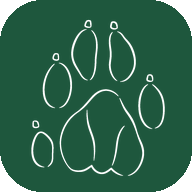
Illustration generated with artificial intelligence from reference sources and reviewed by the team. Use it as a guide, not as a definitive identification key: it may contain errors in anatomical details such as the number of toes, claw marks or the scale. If something looks off, write to us at [email protected]: corrections from people who know the field are what keep improving these plates.
It is the wild ancestor of all domestic pig breeds worldwide, and probably the large mammal with the most extensive and rapidly expanding geographical distribution on the planet today. Its intelligence and adaptability are so remarkable that it has successfully colonised environments as diverse as temperate forests, Mediterranean marshes, and even the outskirts of large European cities. Here, it is increasingly common to see it foraging in bins. Where it has
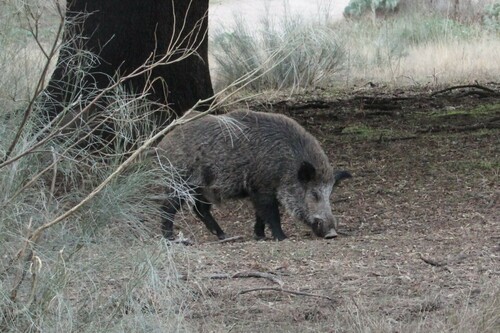
A large suid with a robust body covered in dense, bristly hair, greyish-brown to black in colouring. It has a large, elongated head with a prominent snout and visible tusks in adult males. The young, with light and dark longitudinal stripes, are easily distinguished from uniformly coloured adults. It can be confused with the feral Domestic Pig in some areas where the two interbreed, producing intermediate-looking hybrids.
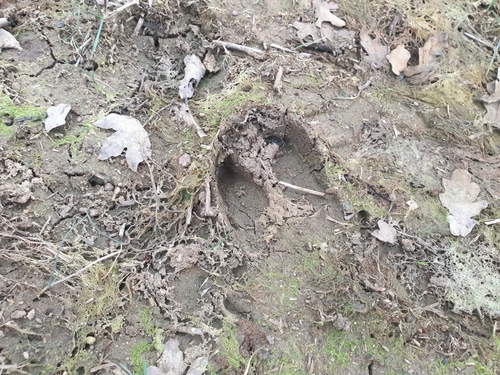
Wide, cloven track, 6-9 cm long. The lateral hooves (accessory toes) are marked even on firm ground, unlike deer, which only mark them on soft ground.
Droppings are cylindrical and segmented, grouped in irregular piles, containing root, fruit, and sometimes hair or small bone remains, depending on recent diet.
It leaves very characteristic rooting marks: strips of disturbed earth
Forest, scrubland, marsh and agricultural margins. The Eurasian Wild Pig is highly tolerant of human-altered environments, from lowlands to mid-mountain areas. Native to much of Eurasia and North Africa; introduced and now fully feral in North America, South America, Australia, and several oceanic islands, where it constitutes a serious pest.
Opportunistic omnivore: roots, fruits, seeds, invertebrates, small vertebrates, and carrion. It locates food primarily by smell, largely obtaining it by rooting the ground with its snout.
It lives in family groups (sounders) of females and young, while adult males are more solitary except during oestrus.
It is very prolific, with numerous litters that can be repeated more than once a year in favourable conditions. This largely explains its rapid expansion where it is introduced.
The Eurasian Wild Pig maintains very large and clearly expanding populations both in its native area of Eurasia and in regions where it has been introduced. This is favoured by its high reproductive rate, its generalist diet, and the reduction of natural predators in many areas.
As a species, it faces no relevant threats. On the contrary, it is the subject of intensive population control programmes in numerous countries. This is due to the damage it causes to crops, traffic accidents, and its role in transmitting diseases to domestic livestock.
See all species accounts for even-toed ungulates · Full species index
Mammaling is a free app for logging the mammals you find. You record a sighting in a moment — even if it's just a track — your life list grows, and the record becomes available to scientific and conservation projects.
It runs on your phone with nothing to install. If you like, it adds to your home screen like any other app.
Open Mammaling