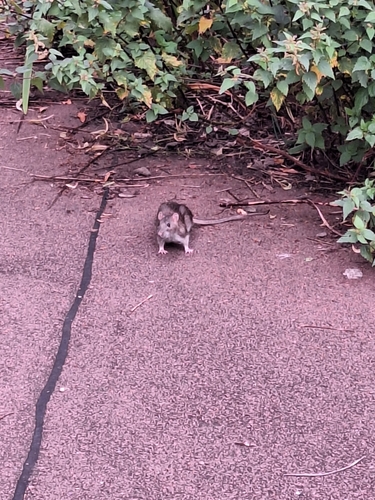
The Brown Rat is probably the most widespread wild mammal on the planet thanks to humans. It can live in any city in the world with access to water and food, from sewers to farms, and reproduces at such a high rate that a single pair can produce hundreds of offspring in a year. It digs complex underground burrows with notable skill and swims with ease. These two traits differentiate it from its more arboreal relative, the Black Rat, with which it shares much of its urban range worldwide. Its relationship with humans is so ancient and close, for better or worse, that it has been simultaneously a pest, a disease vector, and one of the most used laboratory animals in the history of science.
A medium-large rodent with greyish-brown fur, a blunt snout, relatively small, hairy ears, and a tail shorter than the body, thick and uniformly coloured. It differs from the Black Rat by its blunter snout and smaller ears. Crucially, its tail is clearly shorter than its head-and-body length, whereas the Black Rat's tail is longer than its body.
Track with 4 fore toes and 5 hind toes, the hind track 3-4 cm long, with tail drag marks visible in soft substrate.
Droppings are cylindrical with blunt ends, 1.5-2 cm long. They are deposited in large quantities, scattered where activity is frequent, often with many droppings together at a single passage point.
It digs extensive burrows next to foundations, canal banks, and refuse dumps, with entrances 6-8 cm in diameter and characteristic mounds of excavated earth. This behaviour is very different from the predominantly arboreal Black Rat, which rarely digs and is more often detected by gnaw marks at height and nests in lofts or roofs.
Urban areas, sewers, farms, landfills, and watercourse banks, with a strong association with human activity and very little presence in unaltered natural habitat. Distributed almost worldwide except the most extreme polar regions, thanks to involuntary dispersal through human transport from its origin in East Asia.
An opportunistic omnivore with an extremely varied diet, from grain and fruit to meat and human waste, capable of exploiting almost any food source available in its environment.
The Brown Rat lives in hierarchical colonies, maintaining a small home range when food is abundant. It has a very high reproductive capacity, producing several large litters per year under favourable conditions.
It is an excellent swimmer and burrower. Its main activity is nocturnal, though it can be active during the day in areas with low human pressure.
The Brown Rat maintains extremely numerous and expanding populations throughout virtually its entire range, due to its association with humans. There is no sign of decline, nor any need for conservation measures.
It faces no relevant conservation threats. On the contrary, it is the subject of population control campaigns worldwide due to the economic and health damage it causes as an urban and agricultural pest.
See all species accounts for rodents · Full species index
Mammaling is a free app for logging the mammals you find. You record a sighting in a moment — even if it's just a track — your life list grows, and the record becomes available to scientific and conservation projects.
It runs on your phone with nothing to install. If you like, it adds to your home screen like any other app.
Open Mammaling