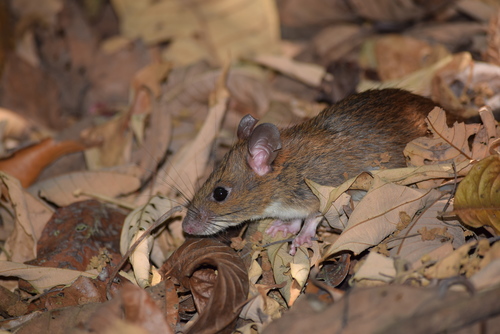
The Roof Rat was the first rat to travel with humans, long before its sewer-dwelling relative. Its exceptional climbing ability allowed it to colonise ships, elevated granaries, and rooftops across half the world from its probable origin in South Asia.
Unlike the Brown Rat, the Roof Rat clearly prefers heights. It lives on rooftops, among rafters, and in treetops with the same ease that other rats live at ground level. This habit gives it its common name of Roof Rat in several languages.
It is also one of the species with the greatest documented impact on island fauna worldwide. On islands without terrestrial predators, it can decimate entire populations of seabirds and endemic reptiles that had never had to defend themselves against a climbing mammal.
A medium-sized rodent with fur varying from black to greyish-brown depending on the population. Its body is more slender than that of the Brown Rat, it has a pointed snout, large, sparsely furred ears, and a tail longer than its head and body length.
It differs from the Brown Rat by its tail, which is longer than its body, its larger, finer ears, and its much more arboreal and less fossorial behaviour.
Tracks show 4 fore toes and 5 hind toes; the hind track is 2.5-3.5 cm long, somewhat finer and with more splayed toes than that of the Brown Rat. The most reliable field difference, however, is the tail. In tracks and signs on soft surfaces, it appears dragged more extensively and continuously. Droppings are cylindrical with somewhat sharper points than those of the Brown Rat, 1-1.5 cm
Urban and agricultural areas, with a clear preference for elevated structures, roofs and attics. It also favours dense arboreal vegetation in warm climates. It is relatively absent from very cold climates, where it is displaced by the Brown Rat.
It is distributed almost worldwide in tropical, subtropical and warm temperate zones. The Roof Rat is always associated with human activity or insular habitats where it has been introduced.
Omnivorous, feeding predominantly on fruit, seed, and grain, unlike the more varied and carnivorous diet of the Brown Rat. This is supplemented with eggs, young birds, and invertebrates depending on availability.
Highly arboreal and primarily nocturnal, it lives in variable-composition groups with a home range that can extend vertically, using beams, wiring, and branches as travel routes. On islands without natural predators, it can reach very high densities, with a strong impact on native fauna.
The Roof Rat has extremely numerous and widespread global populations thanks to its association with humans and maritime transport, showing no signs of decline or any need for conservation measures for the species as a whole.
The Roof Rat faces no relevant conservation threats itself. On the contrary, it is the target of eradication programmes on numerous islands worldwide. This is due to the severe impact it causes on populations of endemic seabirds, reptiles, and invertebrates, which are defenceless against a climbing predator.
See all species accounts for rodents · Full species index
Mammaling is a free app for logging the mammals you find. You record a sighting in a moment — even if it's just a track — your life list grows, and the record becomes available to scientific and conservation projects.
It runs on your phone with nothing to install. If you like, it adds to your home screen like any other app.
Open Mammaling