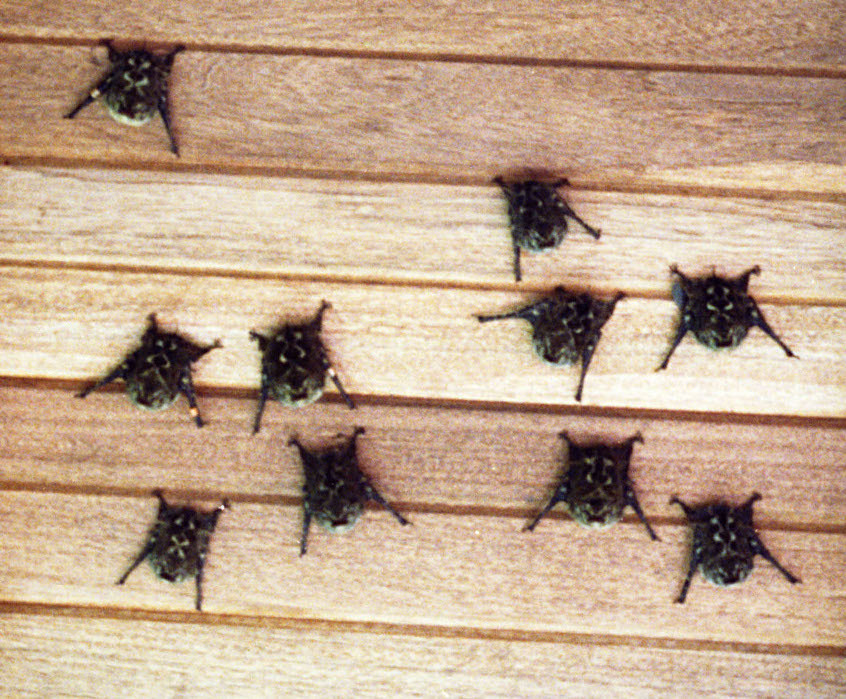
One of the easiest bats to recognise by its behaviour rather than its size, the Proboscis Bat roosts in lines on exposed trunks and branches beside water. Its mottled grey and brown fur camouflages it as bark, and it sways its body in sync with the rest of the group. This constant swaying, easily mistaken for leaves moving in the wind, makes it hard for a predator to distinguish individual outlines among its roost mates. Its common name refers to the elongated, pointed snout that gives it an unmistakable profile.
A small bat with mottled grey and brown fur that mimics the bark of trees beside which it roosts. The elongated, pointed snout that gives the species its name is its most distinctive feature, separating it at a glance from other emballonurids of similar size. It is usually seen in lines with other individuals on exposed trunks near water—an unusual behaviour that helps identify it even without a close-up view.
In search flight, it emits an almost constant frequency component near 100 kHz. This drops to around 67 kHz when chasing prey to widen its peripheral acoustic field of view; lower components around 47 kHz have also been recorded. The broadband sweep can extend from almost 100 kHz down to about 75 kHz in just over 5 milliseconds. The high frequency of its search pulses helps distinguish it acoustically from larger emballonurids such as Saccopteryx, which echolocate around 45-55 kHz. The most characteristic sign of its presence is not guano, but the roost itself: exposed trunks and branches beside water occupied by a line of resting individuals, displaying the species' typical synchronized swaying during the day.
Banks of rivers, streams and other waterbodies in the tropical lowlands of Central and South America.
Insectivorous; hunts small dipterans such as mosquitoes, flies and caddisflies over the water surface.
Forms small colonies that roost in lines on exposed trunks or branches, swaying in sync throughout the day to make detection by predators difficult.
A widespread and common species in habitats with available water, with no signs of an overall decline.
Degradation of riparian vegetation and the waterbodies on which it relies for foraging and roosting.
See all species accounts for bats · Full species index
Mammaling is a free app for logging the mammals you find. You record a sighting in a moment — even if it's just a track — your life list grows, and the record becomes available to scientific and conservation projects.
It runs on your phone with nothing to install. If you like, it adds to your home screen like any other app.
Open Mammaling