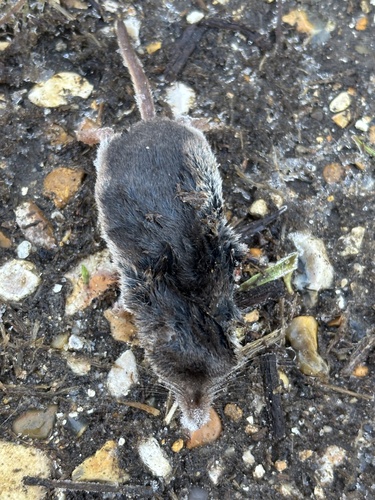
The Common Shrew lives at such a rapid pace that its heart can beat over a thousand times per minute, and it needs to eat every few hours to avoid starvation. This extreme metabolic rate forces it to be active almost constantly, day and night, in short periods separated by brief rests. It is one of the most common and widely studied shrews in Europe, a key subject in numerous scientific
The Common Shrew is a small to medium-sized shrew with tricoloured fur, a dark brown back, paler flanks, a greyish belly, a long, mobile snout, and teeth with dark red-stained tips due to iron deposits. It differs from mice by its elongated snout and tiny eyes, and from the Pygmy Shrew by its larger size and proportionally longer tail.
Small track, 1.5-2 cm long, with 5 toes, rarely visible except in fine mud or fresh snow. Tiny, dark droppings, 4-6 mm long, containing shiny insect chitin remains, left scattered along its routes under leaf litter and dense vegetation. Its presence is mainly revealed by a sharp, repeated squeak when defending its territory from other Common Shrews. It is also indicated by small surface runways through the leaf litter, which are rarely visible to the naked eye.
Forest, hedgerow, meadow, scrubland and farmland with good vegetation cover and leaf litter, from lowlands to mid-mountain areas. Distributed across much of Europe, from northern Spain to western Siberia.
Strictly insectivorous: insects, spiders, earthworms and other small invertebrates, which it locates mainly by smell and the touch of its whiskers. It needs to eat several times its own weight in food every day.
Solitary and highly territorial, the Common Shrew actively avoids contact with other Common Shrews except during oestrus. It does not hibernate. It remains active all year, with short rest periods distributed throughout the day and night. Its life is very brief, rarely exceeding 12-18 months, with a single reproductive season before death.
The Common Shrew maintains large and stable populations in most of its European home range, without signs of widespread decline.
Loss of hedges and habitat with dense vegetation cover due to agricultural intensification, and pesticide use reducing its insect prey, without significant global threats.
See all species accounts for hedgehogs and shrews · Full species index
Mammaling is a free app for logging the mammals you find. You record a sighting in a moment — even if it's just a track — your life list grows, and the record becomes available to scientific and conservation projects.
It runs on your phone with nothing to install. If you like, it adds to your home screen like any other app.
Open Mammaling