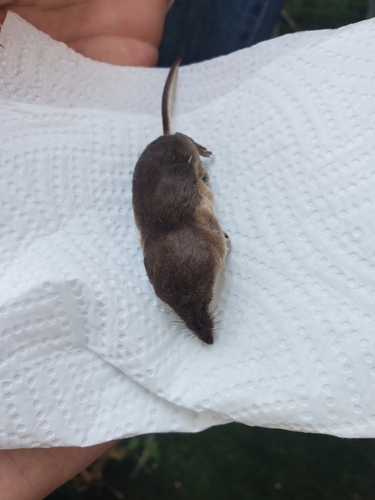
The Crowned Shrew belongs to a group of red-toothed shrews so similar in appearance that they were systematically confused for much of the 20th century. Detailed study of their chromosomes eventually revealed that several distinct species coexisted in Europe. Each had its own set of local chromosomal races, a level of genetic complexity unusual even among mammals.
The Crowned Shrew lives a frantic life typical of shrews. Its metabolism is so fast that it can barely afford a few hours without eating. It alternates short periods of activity and rest, day and night, without stopping throughout its adult life, which rarely exceeds 18 months.
The Crowned Shrew is a small, shrew-like mammal with dark brown dorsal colouring that gradually lightens towards the belly without a sharp demarcation. It has a long, mobile snout and teeth with the reddish tips characteristic of the genus Sorex.
It is often confused with other red-toothed shrews in its range, especially the larger Bicoloured Shrew. Reliable distinction from
Tiny track, barely 1 cm long, rarely visible except on very fine substrate. Tiny, dark droppings, a few millimetres long, with insect chitin remains visible under a magnifying glass, left scattered along its paths under the leaf litter.
It builds spherical nests of grass and moss in hollows under fallen logs, stones, or roots. Its presence is betrayed by a sharp, rapid squeak emitted when communicating or feeling threatened, similar to that of other red-toothed shrews in the region.
Forest, hedgerow, meadow, and field edge with good vegetation cover, from lowlands to mid-mountain areas. Distributed across Western Europe, present in France, the north of the Iberian Peninsula, and neighbouring areas. It occupies the westernmost extent of the red-toothed shrew group, a group distributed across the entire continent.
Insectivorous, the Crowned Shrew feeds on insects, earthworms and other invertebrates. Its very rapid metabolism requires it to eat very often throughout the day and night.
Continuously active in short bursts throughout the day and night, the Crowned Shrew exhibits generally solitary and territorial behaviour outside the breeding season. It is part of a complex of European species and chromosomal races, whose true genetic diversity has only been resolved through detailed karyotype studies.
Populations are generally stable across most of its range, with no documented evidence of widespread decline.
Loss of hedges and edge vegetation in the intensified agricultural landscape, and the use of pesticides, which reduces the availability of invertebrate prey.
See all species accounts for hedgehogs and shrews · Full species index
Mammaling is a free app for logging the mammals you find. You record a sighting in a moment — even if it's just a track — your life list grows, and the record becomes available to scientific and conservation projects.
It runs on your phone with nothing to install. If you like, it adds to your home screen like any other app.
Open Mammaling