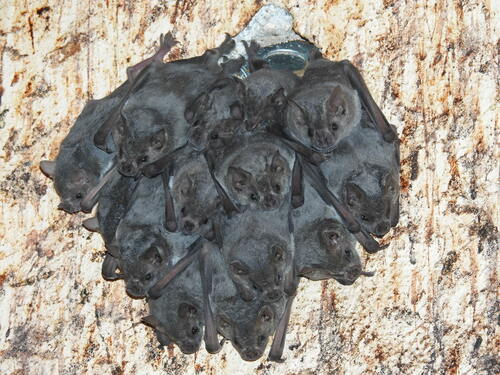
It is an endemic frugivorous forest whale of the Mexican Pacific, where its fur notably longer and dense than that of other related species of the same genre gives it its name and probably helps it to tolerate the freshest nights of the highest altitude areas within its area. Like the rest of its species, it carries the fruit that it collects far from the parent tree before it is eaten, leaving seeds intact for much of the forest and becoming thus one of the most important seed dispersors of the dry tropical forests where it lives. It forms rest colonies in caves, rocky cracks and occasionally human constructions, almost always shared with other species of frugivorous forest whale of the same region. Its ecological role as dispersing, and to a lesser extent, polnarization of tropical
A medium-sized, long and dense brown-gray fur, short fox with a nasal leaf in the shape of a well-visible lance, and absence of external tail. It differs from other species of its same genre present in its area by its notably longer fur, and from other frugivores of the region by the characteristic nasal leaf of its group, absent in insect-eaters.
Dry tropical forest and transitional forest, from low lands to mid-mountain quarters. endemic of the Pacific River of Mexico, from Sonora to Oaxaca.
Frugivorous, it feeds mainly on fig fruit and other tropical tree species, complemented with nectar and occasional pollen.
It forms rest colonies in caves and rocky cracks, often shared with other species of fruitful frogs.It is of night activity, with forage flights that can go several kilometers away from the shelter in search of fruit trees.
Its populations are generally considered stable within its endemic distribution area in Mexico, without signs of significant decline.
Deforestation and fragmentation of dry tropical forests by agricultural and livestock expansion in the Mexican Pacific.
See all species accounts for bats · Full species index
Mammaling is a free app for logging the mammals you find. You record a sighting in a moment — even if it's just a track — your life list grows, and the record becomes available to scientific and conservation projects.
It runs on your phone with nothing to install. If you like, it adds to your home screen like any other app.
Open Mammaling