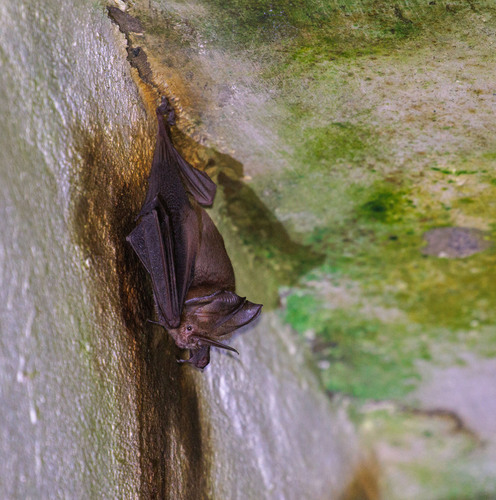
The Common Sword-nosed Bat (Lonchorhina aurita) lives in humid caves in Mesoamerica and northern South America. It is instantly recognisable by an enormous, sword-shaped nose-leaf, the longest in proportion to the head of any American bat. Far from being a mere ornament, this structure helps focus the echolocation beam while hunting in the undergrowth. It forms dense colonies in specific cave chambers, to which it shows great fidelity throughout its life. Its striking appearance contrasts with how little is known about its behaviour outside the caves it inhabits.
It has a forearm 50-58 mm long and an extraordinarily long, lance-shaped nose-leaf, which can reach half the head's length. This feature alone distinguishes it from any other phyllostomid in its range. Its ears are large and its fur is brown. No other sympatric bat has a nose-leaf of comparable proportions, making identification in the hand virtually unequivocal.
Sonograms and echolocation: No published acoustic parameters are sufficiently reliable to include a diagnostic frequency range in this format.
Being a species strongly associated with caves, the most reliable physical tracks and signs are guano accumulations on the floor of occupied chambers, along with moth wing remains under feeding roosts near the entrance. Emergence usually occurs well into the night, after the majority of other cave-dwelling species.
It inhabits humid caves and similar structures in lowland tropical rainforest, from southern Mexico through Central America to northern South America and Trinidad, from sea level up to about 1000 m.
It feeds on insects caught in flight in the undergrowth near the caves it occupies, mainly moths and beetles.
It forms dense colonies of tens to hundreds of individuals in specific humid cave chambers, often shared with other bat species. It shows great fidelity to these roosts over time.
It is widely distributed, with populations considered stable where suitable caves persist without significant disturbance.
Human disturbance of cave roosts, including tourism, guano extraction and vandalism, along with deforestation of the surrounding forest environment, are the main threats.
See all species accounts for bats · Full species index
Mammaling is a free app for logging the mammals you find. You record a sighting in a moment — even if it's just a track — your life list grows, and the record becomes available to scientific and conservation projects.
It runs on your phone with nothing to install. If you like, it adds to your home screen like any other app.
Open Mammaling