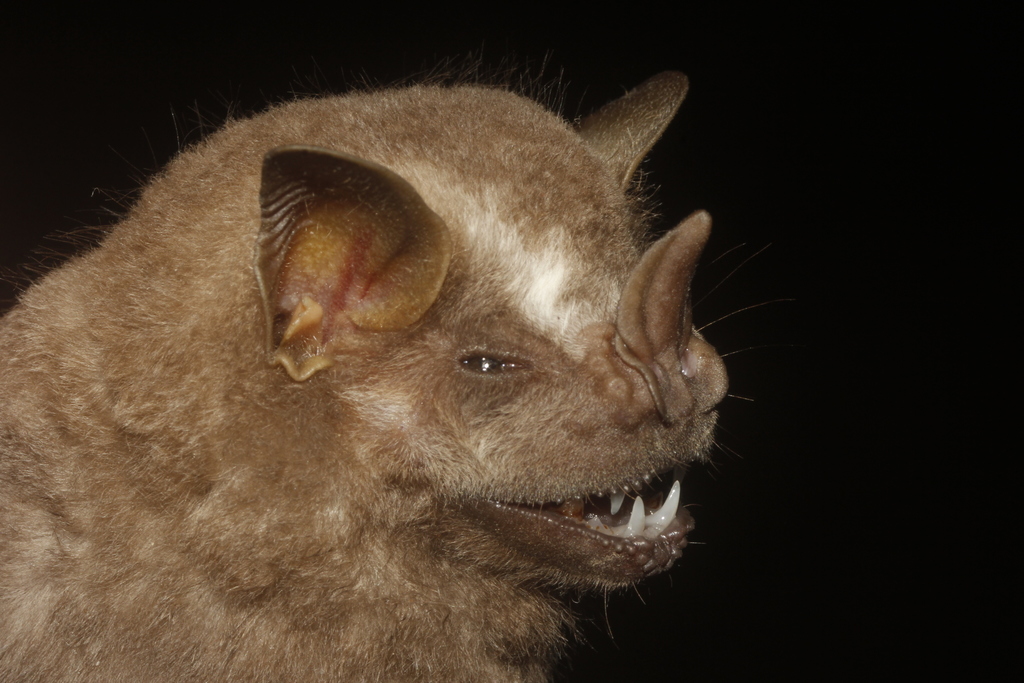
Its taxonomic status has been debated for decades: some specialists treat it as a distinct species of Mesoamerican fruit bat, whereas others consider it a mere subspecies of the Great Fruit-eating Bat, which has a much wider South American distribution. Genetic and morphological studies published to date have failed to settle the debate conclusively. Whatever its ultimate status, this is a robust fruit-eating bat of Mesoamerican lowlands and mid-elevations, dispersing seeds of fig and other tropical trees by carrying fruit away from the parent tree before consuming it. It inhabits tropical forest and transitional forest, forming roosting colonies in caves, tree hollows and dense foliage; its ecological role as a seed disperser is virtually identical to that of other bats of its genus in the region.
A medium-sized bat, somewhat smaller than the Great Fruit-eating Bat, of which it may simply be a regional form. It has greyish-brown fur, a short snout with a spear-shaped noseleaf, and lacks an external tail. Field identification to distinguish it from other forms of the same complex is extremely difficult without precise cranial measurements, precisely because of the taxonomic uncertainty surrounding this population.
Tropical moist forest and transitional forest, from lowlands up to mid-mountain elevations. Distributed across Mesoamerica, from central Mexico into Central America.
Frugivorous, feeding mainly on the fruit of fig and other tropical trees, supplemented with occasional nectar.
Forms roosting colonies in caves, tree hollows and dense foliage, making nocturnal foraging flights to fruiting trees that may be several kilometres from the roost.
Its populations, evaluated alongside those of the rest of the Great Fruit-eating Bat complex, are generally considered stable across most of its Mesoamerican range.
Deforestation and tropical forest fragmentation caused by agricultural and livestock expansion in Mesoamerica.
See all species accounts for bats · Full species index
Mammaling is a free app for logging the mammals you find. You record a sighting in a moment — even if it's just a track — your life list grows, and the record becomes available to scientific and conservation projects.
It runs on your phone with nothing to install. If you like, it adds to your home screen like any other app.
Open Mammaling