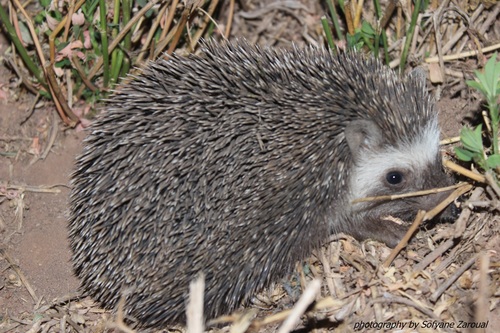
The North African Hedgehog has a paler facial mask and longer ears than its European relative. It can withstand much more arid and hotter landscapes than any hedgehog from central and northern Europe could tolerate. Its arrival on several Western Mediterranean islands, where it is now considered a common part of the landscape, is not a natural phenomenon. Instead, it is the result of very old introductions linked to maritime trade, possibly since Roman times or even earlier. This makes it an early example of a species moved by humans long before the modern concept of an invasive species existed. Unlike the European Hedgehog, it does not need to hibernate in most of its area, thanks to a climate that rarely requires it to spend winter in deep torpor.
The North African Hedgehog is a small to medium-sized hedgehog, somewhat smaller than the European Hedgehog. It has brown spines and a noticeably paler, almost white, face, lacking the dark mask of the European Hedgehog. Its ears are proportionally longer and visible above the spines. It differs from the European Hedgehog, with which it may overlap in the southern Iberian Peninsula, by this pale, mask-less face and its longer, more prominent ears.
Small tracks, 2.5-3 cm long, with five toes on the hind foot and four on the front, and visible claw marks. They are very similar to those of the European Hedgehog and difficult to distinguish by tracks and signs alone, except by geographical context.
Droppings are cylindrical and somewhat twisted, 3-5 cm long, with visible insect chitin remains, deposited sparsely throughout its home range.
The North African Hedgehog builds shallow nests under dense vegetation, stone walls or rubble. These are simpler and less insulated than the hibernation nests of the European Hedgehog, as in most of its range it does not need to hibernate.
Arid and semi-arid scrubland, coastal dunes, orchards, and gardens, showing good tolerance for human proximity, from sea level up to low mountain areas.
Native to North Africa, from Morocco to Libya. It was introduced centuries ago to several Western Mediterranean islands, including some of the Balearics, and to specific locations on the Mediterranean coast of the Iberian Peninsula and southern France.
Insectivorous and an opportunistic omnivore, the North African Hedgehog feeds on insects, worms, snails, and occasionally fallen fruit and small vertebrates. It seeks these mainly by smell during its nocturnal forays.
Solitary and mainly nocturnal, it forages across its home range on the ground. Unlike the European Hedgehog, it does not need to enter deep hibernation in most of its range due to the warmer climate. However, it may reduce its activity during the coldest or driest periods of the year.
Populations are generally stable both in its native North African range and in areas where it has been introduced, with no signs of widespread decline. However, specific population data are limited across much of its range.
Roadkill, especially in urbanised coastal areas; pesticide use, reducing the availability of invertebrate prey; and predation by domestic and feral cats in some island introduction areas.
See all species accounts for hedgehogs and shrews · Full species index
Mammaling is a free app for logging the mammals you find. You record a sighting in a moment — even if it's just a track — your life list grows, and the record becomes available to scientific and conservation projects.
It runs on your phone with nothing to install. If you like, it adds to your home screen like any other app.
Open Mammaling