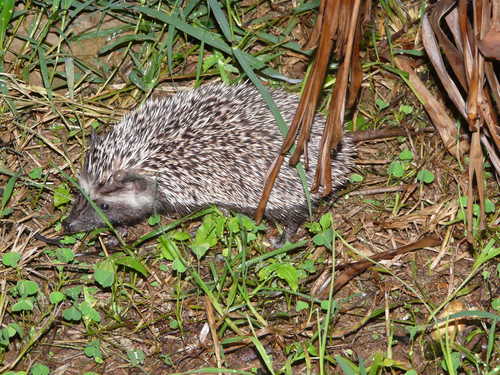
With a band of white spines crossing its forehead like a tiara, this small hedgehog spends the day curled into a spiny ball under vegetation and comes out at night to look for insects in gardens, savannahs and scrub of southern Africa. It is one of the hardest mammals to survey on the continent, precisely because its best defence, keeping still and rolling up, makes it almost invisible even to someone standing in front of it. Much of what is known about its present distribution comes from citizen sightings in urban gardens.
Body covered in short, stiff spines on the back, with a characteristic band of white spines crossing the forehead from side to side. Face, belly and legs covered in dark brown hair without spines. It differs from the White-bellied Hedgehog, which does not share a range in the far south of the continent, by this very marked white frontal band.
Small track about 2-3 cm long, with five toes on both fore and hind feet, seldom found because of its low weight. Droppings are elongated and dark, 1-2 cm long, and often contain shiny beetle exoskeleton remains. The clearest sign is usually the nest itself, a pile of leaves and dry grass under dense bush or in a natural hollow, used as a daytime refuge.
Savannah, scrub, grassland and also gardens and urban fringes, from sea level to mid altitudes, in southern Africa: South Africa, Lesotho, Eswatini, Botswana, Namibia, southern Angola and western Zimbabwe.
Insects and their larvae, especially beetles, as well as other small invertebrates, eggs of ground-nesting birds and occasionally small vertebrates or carrion.
Solitary and nocturnal, it spends the day curled up in a leaf-litter nest. In the colder parts of its range it may enter a state of torpor during the coldest days of winter to save energy, without this amounting to full hibernation.
At global level the species is considered low risk because of its wide distribution. However, the South African regional assessment places it in a category of greater concern, given that much of its savannah and grassland habitat is being lost to agricultural and urban expansion, and there are no population density studies that would allow real trends to be confirmed.
Habitat loss from agricultural and urban expansion, roadkill, use of snail and slug poisons in gardens, and attacks by domestic dogs.
See all species accounts for hedgehogs and shrews · Full species index
Mammaling is a free app for logging the mammals you find. You record a sighting in a moment — even if it's just a track — your life list grows, and the record becomes available to scientific and conservation projects.
It runs on your phone with nothing to install. If you like, it adds to your home screen like any other app.
Open Mammaling