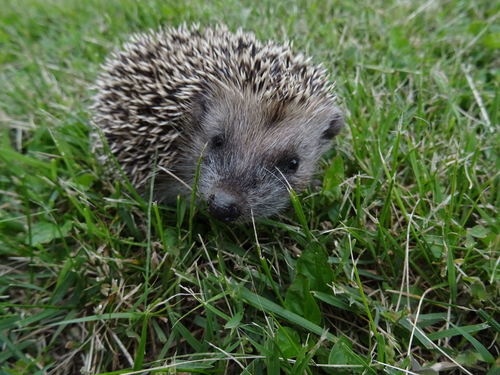

Illustration generated with artificial intelligence from reference sources and reviewed by the team. Use it as a guide, not as a definitive identification key: it may contain errors in anatomical details such as the number of toes, claw marks or the scale. If something looks off, write to us at [email protected]: corrections from people who know the field are what keep improving these plates.
Few defences are as simple and effective as rolling into a ball of spines. The West European Hedgehog is one of the most recognisable mammals in gardens and hedgerows across much of Europe, though it is becoming harder to find. Its populations have declined sharply in recent decades in some areas, enough to have recently changed its conservation status. It spends much of winter in deep torpor, and at night covers surprising distances for such a small animal in search of slugs and beetles.
Small insectivore covered in 5000-7000 spines, with greyish-brown fur on its face, belly and legs, and a pointed snout. It rolls into a complete ball as a defence against threats. In eastern Europe, its range overlaps with the Oriental Hedgehog, from which it can only be reliably distinguished by cranial details.
Tracks, 2.5-3 cm long and with 5 toes, are rarely visible except in fine mud. Droppings are cylindrical, dark and shiny, 3-5 cm long, with beetle elytral remains. They are scattered throughout the home range. It builds nests of leaves and grass under hedges or logs, which it uses to hibernate. Its nocturnal search for food among the vegetation produces audible snorts and grunts.
Forest with undergrowth, hedges, gardens, parks and agricultural areas with vegetation cover, up to medium altitudes. Distributed throughout Western and Central Europe.
It feeds mainly on invertebrates (beetles, caterpillars, earthworms, slugs), and occasionally on eggs, carrion and fallen fruit.
It is solitary, hibernating between October-November and March-April in temperate climates, depending on the area and accumulated fat reserves. It roams a wide home range at night and produces 1-2 litters of 4-5 young per year, in summer.
The species was moved to a higher category of concern in 2023 after a decline approaching or exceeding 30% was documented over ten years across large parts of its range. This decline is especially notable in the United Kingdom and other parts of northwest Europe, although trends are more stable in some eastern regions.
Roadkill, use of pesticides and molluscicides, loss of hedgerows and traditional agricultural habitat, and alteration of hibernation cycles due to climate change.
See all species accounts for hedgehogs and shrews · Full species index
Mammaling is a free app for logging the mammals you find. You record a sighting in a moment — even if it's just a track — your life list grows, and the record becomes available to scientific and conservation projects.
It runs on your phone with nothing to install. If you like, it adds to your home screen like any other app.
Open Mammaling