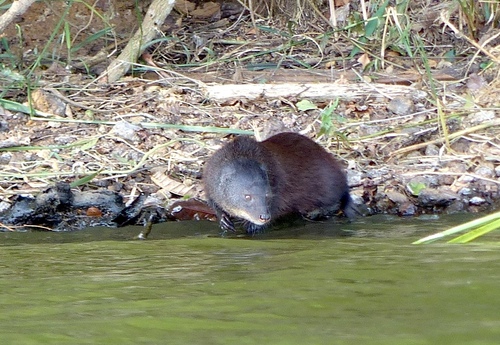
Unlike almost all its relatives, this mongoose hardly strays from water. It hunts crabs, frogs and molluscs with its fore paws, feeling about under stones and in the mud almost as a Raccoon would, and can submerge completely to chase an elusive prey. It lives alone along rivers, marshes and coastal areas of much of sub-Saharan Africa. Its reputation as a fierce, territorial animal is well documented: it is known to stand up without hesitation to domestic dogs several times its size.
Robust body with long, coarse fur, a nearly uniform dark greyish brown, without the stripes or spots of other African mongooses. Long, bushy tail and elongated snout. It differs from other mongooses in its longer, scruffier coat and its almost constant association with watercourses.
Five-toed track about 4-5 cm long, almost always in the mud of river and marsh banks. Droppings, often full of crab carapace and mollusc shell remains, are deposited in latrines near the water. Stones overturned beside the bank, with the damp mark of the hollow they left, are a clear sign of recent foraging.
Any habitat with permanent or semi-permanent fresh water: rivers, marshes, lakes, and also coastal areas with mangrove swamps, from sea level to mountain areas, across much of sub-Saharan Africa.
Freshwater crabs, frogs, molluscs, small fish and aquatic insects, which it locates mainly by feeling about with its fore paws under water and among stones.
Strictly solitary outside the mating season, with males and females meeting only to breed. Mainly nocturnal and crepuscular, although it can be seen active by day in quiet areas.
The species has a wide distribution and is considered low risk at global level. However, its populations depend entirely on wetlands and watercourses, one of the most threatened ecosystems in Africa, so local declines are seen wherever these habitats are degraded or disappear.
Loss and pollution of wetlands through agricultural drainage and urban development, and accidental capture in traps set for other animals near watercourses.
See all species accounts for carnivores · Full species index
Mammaling is a free app for logging the mammals you find. You record a sighting in a moment — even if it's just a track — your life list grows, and the record becomes available to scientific and conservation projects.
It runs on your phone with nothing to install. If you like, it adds to your home screen like any other app.
Open Mammaling