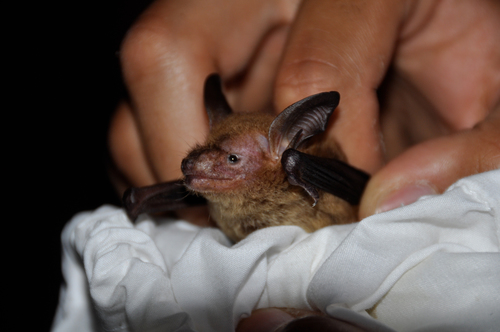
One of the least known bats in Mesoamerica, Van Gelder's Bat is so rare in field records that for decades specialists had only a handful of captured specimens with which to study its biology. It inhabits tropical dry forest and transition zones to wetter woodland, roosting in large tree hollows and caves—a habitat increasingly fragmented across much of its Mesoamerican range. Its common name honours the American zoologist who first described it in the mid-20th century. Its scarcity in captures contrasts with its broad potential distribution, suggesting it remains an under-sampled species rather than genuinely scarce everywhere.
A medium-sized bat with dark brown to reddish fur, medium-sized rounded ears, and a robust build for a vespertilionid. It is easily confused with other Mesoamerican bats of similar size and colour. Its scarcity in captures and its association with large tree hollows in tropical dry forest help guide field identification, though they do not guarantee it.
Tropical dry forest and transition zones to wetter woodland, roosting in large tree hollows and caves, from lowlands to lower mountain zones. Distribution is fragmented from north-western Mexico to Central America, including Costa Rica.
Insectivorous, hunting flying insects, although specific details of its hunting technique and preferred prey remain poorly known.
Its habits are poorly documented due to the scarcity of field records. It roosts in large tree hollows and caves, with a social behaviour that may be more solitary than that of other, better-studied vespertilionid species in the region.
Considered locally uncommon throughout its range, with indications of population decline linked to the loss of the tropical dry forest on which it depends—one of the most threatened and least protected ecosystems in Mesoamerica.
Deforestation and fragmentation of tropical dry forest due to agricultural and livestock expansion, along with the loss of large trees providing hollows for roosting.
See all species accounts for bats · Full species index
Mammaling is a free app for logging the mammals you find. You record a sighting in a moment — even if it's just a track — your life list grows, and the record becomes available to scientific and conservation projects.
It runs on your phone with nothing to install. If you like, it adds to your home screen like any other app.
Open Mammaling