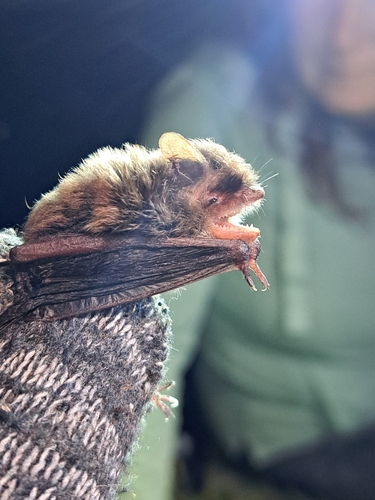
Described so recently that it was only recognised as a distinct species early in the 21st century, the Alcathoe Whiskered Myotis was uncovered when genetic analysis revealed that individuals long assumed to be small specimens of other Myotis species were in fact a separate lineage, hidden so well that it had gone unnoticed through decades of European wildlife study. It is one of the continent's smallest bats, barely larger than a big bumblebee, and is restricted to well-preserved riparian woodland, an increasingly scarce habitat that limits its presence to the best-preserved stretches of river. Its late discovery is a clear reminder that even in a continent as thoroughly studied as Europe, the bat fauna still holds surprises.
A tiny bat, among the smallest in Europe, with glossy reddish-brown fur on the back and paler underparts, medium-sized ears and a pointed tragus. In the hand it is virtually indistinguishable from other small Myotis species, particularly the Whiskered Bat and Brandt's Bat, with which it forms a sibling species group whose reliable separation almost always requires genetic analysis.
Peak frequency between 45 and 52 kHz. Wideband FM pulse with a very steep sweep, appearing on the detector as a short, almost vertical trace, similar to that of other small Myotis species. Duration 2-4 ms. Not reliably separable from the Whiskered Bat or Brandt's Bat by sonogram: all three species share a virtually identical acoustic pattern, and confirming the exact species from sound alone is a common identification error that should be avoided in this group. Beneath feeding roosts in riparian woodland, small prey remains and tiny, fibrous scatterings of guano may be found; tracks and signs also include its emergence timing, which is relatively late, well after dusk.
Well-preserved riparian woodland and mature deciduous forest close to water, from lowlands up to mid-altitude mountain areas. Distributed in a fragmented pattern across much of Europe, with confirmed records in numerous countries following its recent recognition as a distinct species, though its precise range continues to be refined.
Insectivorous, hunting small flying insects and spiders close to the foliage of riparian trees, with a slow, agile flight amongst dense vegetation.
Forms small maternity colonies in tree holes in riparian woodland, showing a strong reliance on this increasingly scarce habitat. As it was described so recently, much of the detail regarding its reproductive and social biology is still being documented.
A lack of sufficient population data, arising partly from its recent recognition as a distinct species and the difficulty of separating it from sibling species without genetic analysis, currently prevents a reliable assessment of its population trends.
Loss and degradation of mature riparian woodland with suitable tree holes for roosting, canalisation of watercourses that destroys the bankside vegetation on which it relies, and insecticide use that reduces prey availability.
See all species accounts for bats · Full species index
Mammaling is a free app for logging the mammals you find. You record a sighting in a moment — even if it's just a track — your life list grows, and the record becomes available to scientific and conservation projects.
It runs on your phone with nothing to install. If you like, it adds to your home screen like any other app.
Open Mammaling