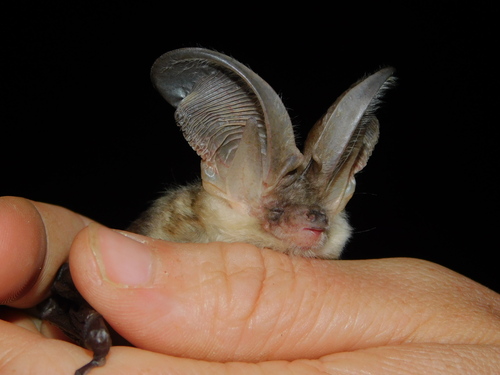
The Alpine Long-eared Bat (Plecotus macrobullaris) is a relatively recently recognised species. It lives in mountain areas much higher than its lowland relatives, with colonies documented above 2000 metres in some southern European mountain ranges. It shares with other long-eared bats the enormous ears and almost silent, whispering flight characteristic of the entire genus. However, its preference for high-mountain rock faces and crevices instead of woodland or attics distinguishes it in terms of habitat from its better-known relatives. In appearance, it is practically impossible to differentiate from them without capture. Its scientific name refers to the relatively large size of a cranial bone structure. This technical detail well illustrates how subtle the differences can be between very closely related bat species.
A small to medium-sized bat with enormous ears characteristic of the entire genus, almost as long as its body, and foldable under the wing at rest. It is practically indistinguishable in the field from its lowland long-eared relatives. Altitude and roost type – mountain rock faces instead of forest or attic – help guide identification better than any visual feature. Reliable confirmation, however, requires genetic or cranial analysis.
Peak energy frequency between 25 and 50 kHz, with a downward sweep. It emits an FM-type pulse of very low intensity. This 'whispering' bat produces a weak, short trace on the detector screen. Duration 2 to 5 milliseconds. It cannot be reliably distinguished from other European long-eared bats by sonogram. The entire group shares a very similar whispering call pattern.
The Alpine Long-eared Bat inhabits rock faces and crevices in high mountains, and mountain coniferous forest, generally above 1000 m and with documented records above 2000 m in some mountain ranges. It is fragmentedly distributed across the main mountain ranges of southern Europe and parts of western Asia.
Insectivorous, it specialises in moths and other slow-flying insects, locating them largely by ear and often collecting them directly from rock or mountain vegetation where they are perched.
The Alpine Long-eared Bat forms small breeding colonies in high-mountain rock crevices. Its behaviour is similar to other long-eared bats, but it is tied to a much higher and rockier habitat. Described relatively recently, many details of its biology are still being documented.
Its populations are generally considered stable across most of its known mountain range, though a lack of specific studies in many mountain ranges limits precise understanding of its actual status.
Unregulated sport climbing on high-mountain rock faces used as breeding refuges. More generally, the altitudinal shift of vegetation associated with climate change could alter the long-term availability of suitable habitat.
See all species accounts for bats · Full species index
Mammaling is a free app for logging the mammals you find. You record a sighting in a moment — even if it's just a track — your life list grows, and the record becomes available to scientific and conservation projects.
It runs on your phone with nothing to install. If you like, it adds to your home screen like any other app.
Open Mammaling