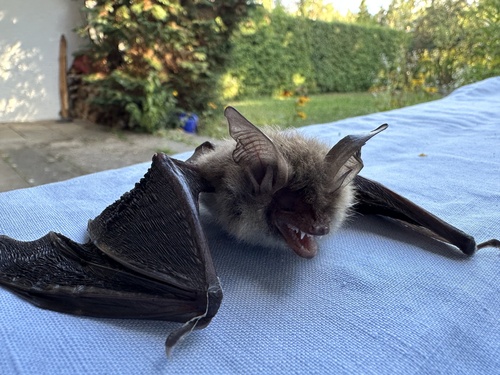
It has disproportionately large ears, even for a genus of bats renowned for their long ears. It uses this trait to detect sounds made by insects moving on leaves, rather than for conventional echolocation.
Bechstein's Myotis is one of the European bats most closely associated with mature forests throughout its life. It travels very few kilometres between its birthplace and its adult breeding roost, which is unusual for bats, as they typically travel much further. Its breeding colonies change roosts within the same forest almost every few days, rotating among dozens of different tree cavities throughout a single season.
Bechstein's Myotis is a medium-sized bat. It has reddish-brown fur on its back and light greyish fur on its belly. Its ears are very long, longer than in most bats of its size, though they are separated at the base, unlike the Barbastelle.
It differs from other Myotis species by that combination of very long ears and reddish fur. It can be distinguished from the Long-eared Bat by its more elongated muzzle and its ears, which are proportionally somewhat shorter.
It leaves no identifiable terrestrial tracks and signs. Droppings are small and friable, 6-9 mm long, containing chitin remains from a wide variety of insects. They accumulate under tree hollows used as roosts, which Bechstein's Myotis often changes frequently within the same forest.
At night, it often hunts very close to foliage, even perching briefly on leaves to capture immobile prey. This is an ambush hunting technique unusual among bats of its size.
Prefers mature woodland, especially deciduous, with abundant old tree hollows for roosting. It shows low tolerance for highly fragmented or deforested landscapes.
Distributed across much of Europe, from lowlands to mid-mountain areas, with generally scarce and localised populations even within its home range.
Insectivorous, Bechstein's Myotis hunts moths, beetles and other insects, often caught directly from foliage using a slow, highly manoeuvrable flight technique close to vegetation.
Bechstein's Myotis forms female maternity colonies in tree hollows, changing roosts very frequently within a small forest area, and showing strong fidelity to its natal forest. It hibernates in winter in caves, mines or rock crevices, and makes short seasonal movements, much shorter than those of other European bats.
Its populations are generally considered scarce and localised across most of its European distribution range, with trends varying greatly by region, primarily depending on the availability of mature woodland with old trees.
Loss and fragmentation of mature forest with old trees due to intensive forest management. Use of pesticides reduces its insect prey. Bechstein's Myotis also has a strong dependence on very specific roosts, which limits its ability to adapt to habitat loss.
See all species accounts for bats · Full species index
Mammaling is a free app for logging the mammals you find. You record a sighting in a moment — even if it's just a track — your life list grows, and the record becomes available to scientific and conservation projects.
It runs on your phone with nothing to install. If you like, it adds to your home screen like any other app.
Open Mammaling