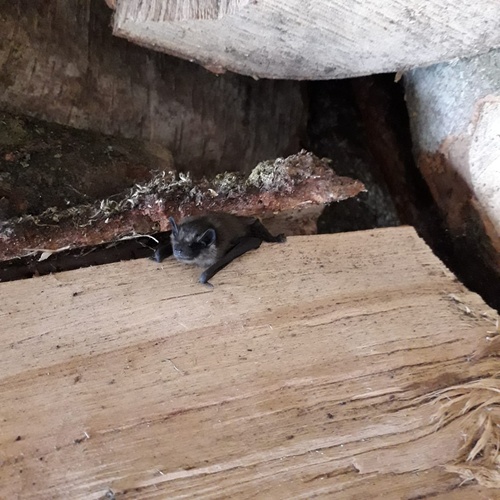
It is one of the largest bats and among the easiest to see at dusk across much of Europe. Its flight is high, powerful, and relatively straight, reminiscent of a small nightjar rather than the typical fluttering of other bats. Its common name alludes to its habit of being among the first to emerge for hunting after sunset, when the light has not yet completely faded. This habit makes it easy to observe with the naked eye before it gets completely dark.
It shares a very recent evolutionary history with its Mediterranean sister species. It separated from this species relatively recently in evolutionary terms, and continues to overlap with it. In the wide band where both species co-occur, they remain practically indistinguishable both visually and by sound.
The Eurasian Serotine is a medium-large bat, one of the largest in Europe, with uniform dark brown fur and short, rounded ears. Its flight is high, fast and fairly straight, often visible at dusk while there is still residual light. It is practically indistinguishable in the hand from Cnephaeus isabellinus, its Mediterranean sister species. The two species overlap in southern Europe, and reliable identification between them often requires genetic analysis.
Peak energy frequency between 24 and 29 kHz. FM-QCF pulse type: begins with a brief descending sweep that stabilises into an almost constant part. On a detector, this appears as an initially inclined trace that flattens into a low horizontal bar. Long duration, 10 to 20 milliseconds, with a wide pulse interval characteristic of open-space flight. Cannot be reliably separated from Cnephaeus isabellinus by sonogram in the southern European overlap zone, where both species share an almost identical acoustic pattern. Outside this zone, a slightly lower frequency aids identification but does not fully guarantee it. Under feeding perches, often eaves and large trees, elongated, somewhat shiny guano accumulates, containing beetle chitin remains. Urine stains are also found on nearby walls. The Eurasian Serotine emerges relatively early, shortly after sunset, hence its common name.
Urban, suburban, agricultural, and woodland-edge areas across much of Europe and western Asia. It shelters in building crevices, eaves, and tree hollows, from lowlands to mid-mountain areas.
Distributed across much of Europe, extending into western Asia. Its range overlaps with its Mediterranean sister species in the south of the continent.
Insectivorous, the Eurasian Serotine primarily hunts medium-large beetles and moths in high, direct flight, often around streetlights and other artificial light sources that concentrate insects.
The Eurasian Serotine forms breeding colonies in building crevices and eaves, tolerating urban environments well. Its high, fast, and fairly straight flight makes it less dependent on linear landscape features than other species with slower, more manoeuvrable flight. It is usually among the first bats to emerge each night.
Eurasian Serotine populations are generally considered stable across most of Europe, favoured by its good adaptation to urban and peri-urban environments, with no signs of widespread decline on a continental scale.
Restoration and sealing of old buildings eliminates breeding roosts in cracks and eaves; insecticide use reduces the availability of large prey; and occasional collision with vehicles occurs during low flight in urban areas.
See all species accounts for bats · Full species index
Mammaling is a free app for logging the mammals you find. You record a sighting in a moment — even if it's just a track — your life list grows, and the record becomes available to scientific and conservation projects.
It runs on your phone with nothing to install. If you like, it adds to your home screen like any other app.
Open Mammaling