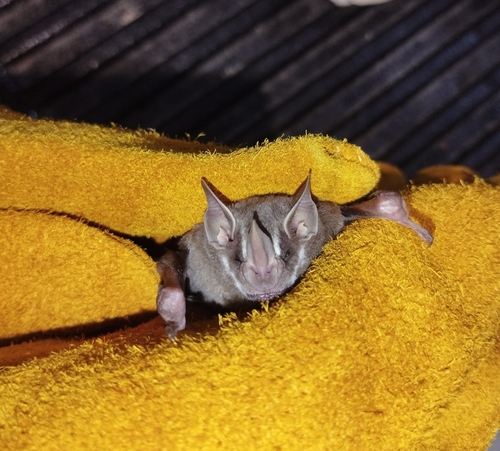
The Pygmy Fruit-eating Bat is, as its name suggests, one of the smallest bats in the entire American tropical forest, so tiny it almost fits entirely in the palm of a hand. Despite its size, it shares with much larger relatives the habit of building small leaf shelters by modifying large leaves of palms and other plants. It does this by biting the veins until the leaf folds and forms an improvised
The Pygmy Fruit-eating Bat measures just 3.5-4.5 cm head-body length and weighs 8-12 g, placing it among the smallest fruit-eating bats in America. It has well-marked whitish facial stripes on both sides of its face, more visible than in other Dermanura species, and a simple nose-leaf. It differs from other sympatric Dermanura species mainly by its notably smaller size and the more marked contrast of its facial stripes.
Humid tropical rainforests and lowland secondary forests, from southern Mexico to Colombia and Venezuela.
It feeds on small fruits, mainly figs and pioneer plant species, which it locates and transports to nearby feeding perches.
The Pygmy Fruit-eating Bat is nocturnal. It builds tent-like roosts by biting the veins of large leaves, which it folds to create a space protected from rain and predators. It usually roosts in small groups under these modified leaves.
It has a wide distribution across Central America and northern South America, with no documented signs of widespread population decline.
Deforestation of lowland tropical rainforest is the main pressure on the species.
See all species accounts for bats · Full species index
Mammaling is a free app for logging the mammals you find. You record a sighting in a moment — even if it's just a track — your life list grows, and the record becomes available to scientific and conservation projects.
It runs on your phone with nothing to install. If you like, it adds to your home screen like any other app.
Open Mammaling