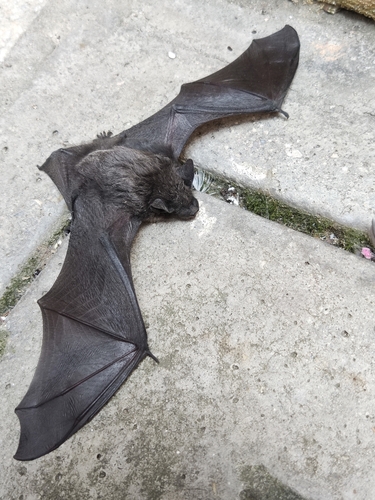
Savi's Pipistrelle is one of the highest and fastest-flying bats of its size. It can hunt in full flight over rocky cliffs and crags where few other small bats venture, with a powerful, direct flight style more reminiscent of much larger species.
It is equally at home on high mountain rock faces as in the tallest buildings of Mediterranean cities. These two habitats, though seemingly disparate, share exactly what the species needs: narrow, vertical crevices for shelter.
Its name honours the Italian naturalist who first described it, in a region where Savi's Pipistrelle remains today one of the most common and easiest bats to detect at dusk.
Savi's Pipistrelle is a small-medium sized bat, slightly larger than Common Pipistrelles. It has bright dark brown fur on its back, paler fur on its belly, and short, rounded ears. Its flight is high and fast in open spaces.
It is confused with Kuhl's Pipistrelle, which is similar in size and habits, and difficult to distinguish from it with the naked eye. The white wing edge, present in Kuhl's Pipistrelle but absent in Savi's Pipistrelle, is the most reliable feature when in hand.
Peak frequency between 33 and 41 kHz. FM-QCF pulse type: it starts with a brief downward sweep that stabilises into an almost constant part. On the detector, this appears as an initially inclined trace that flattens into a horizontal bar. Duration 6-12 milliseconds, with pulse interval shortening during hunting flight near rock or vegetation.
It is difficult
Rocky areas, cliffs, and high mountains. Also found in urban and peri-urban areas with tall buildings that mimic a rock face, from sea level to high mountain areas. Distributed across Southern Europe, North Africa, and parts of Western and Central Asia, with good tolerance for both natural rocky habitat and highly urbanised environments.
Insectivorous, it hunts moths and other small to medium-sized flying insects in high, fast flight, often over rocky outcrops, coastal cliffs or between tall buildings.
Savi's Pipistrelle forms breeding colonies in rock or building crevices, showing good tolerance for human proximity in urban areas of southern Europe. Its high, fast, powerful flight allows it to exploit open, windy spaces, such as coastal cliffs, where other slower-flying bats struggle to hunt.
Its populations are generally considered stable across most of its Mediterranean range, favoured by its good adaptation to both natural rocky habitats and urban environments, with no signs of widespread decline.
Restoration and sealing of cracks in old buildings, eliminating urban breeding roosts; use of insecticides, reducing prey availability; and unregulated sport climbing on rocky cliffs used as breeding roosts.
See all species accounts for bats · Full species index
Mammaling is a free app for logging the mammals you find. You record a sighting in a moment — even if it's just a track — your life list grows, and the record becomes available to scientific and conservation projects.
It runs on your phone with nothing to install. If you like, it adds to your home screen like any other app.
Open Mammaling