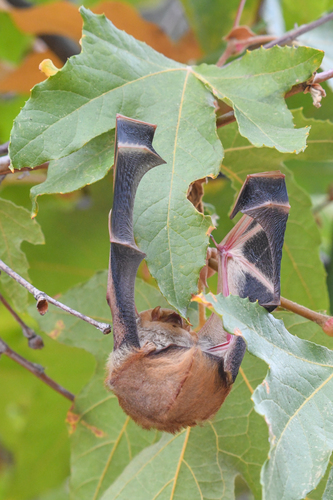
Until a few years ago this reddish bat of western North America and Central America was regarded as simply a population of Lasiurus blossevillii, the red bat of South America and the southern United States. Recent genetic work revealed a marked divergence between the North American, Central American and South American forms, leading the first two to be recognised as a separate species. Like other Lasiurus, it roosts alone among foliage, almost perfectly camouflaged by its reddish fur. Because the split is so recent, much of the published information on Lasiurus blossevillii in North America in fact refers to this species.
Total length 90-110 mm, with a forearm of 35-42 mm. The fur is reddish to orange-red, much like that of Lasiurus borealis, with which it can easily be confused where their ranges approach one another in central Mexico. The ears are short and rounded. Reliable separation from L. borealis, and from South American L. blossevillii sensu stricto, depends chiefly on genetics and geography rather than on any consistent external feature.
Sonograms and echolocation: because the species was recognised so recently, no acoustic parameters have yet been published specifically and reliably for it, separate from those historically attributed to Lasiurus blossevillii. With the information available it is not possible to give a diagnostic frequency range without risking a wrong identification. As in other Lasiurus, it roosts loose among foliage with no fixed shelter, so chancing upon an individual hanging among the leaves remains the most reliable physical sign of its presence.
It occupies temperate woodland, scrub and semi-arid country from the western United States to Costa Rica, roosting among the foliage of trees and shrubs.
It feeds on night-flying insects, including moths and beetles, taken on the wing over open vegetation or near water.
It is solitary, roosting singly among foliage. The northernmost populations make seasonal migratory movements, while in Central America the species appears more sedentary. Breeding and other behavioural details have historically been studied under the name L. blossevillii, so some of that information needs reinterpreting after the taxonomic split.
Because it has only recently been recognised as distinct from Lasiurus blossevillii, it has no independent IUCN assessment; the existing assessments apply to the South American species in the broad sense, before the split.
Loss of forest and riparian vegetation, together with insecticide use that reduces the supply of prey, are the threats assumed for it by comparison with other Lasiurus species in the region.
See all species accounts for bats · Full species index
Mammaling is a free app for logging the mammals you find. You record a sighting in a moment — even if it's just a track — your life list grows, and the record becomes available to scientific and conservation projects.
It runs on your phone with nothing to install. If you like, it adds to your home screen like any other app.
Open Mammaling