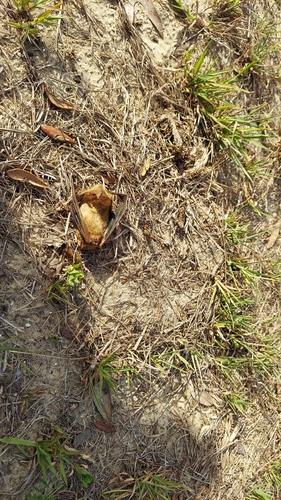
Along the coastal plain of the southeastern United States and eastern Mexico, the Northern Yellow Bat, the largest of the American yellow bats, hangs among clumps of Spanish moss or palm fronds. Its size allows it to capture larger prey than its smaller Lasiurus relatives, including robust beetles and flying bugs. It has disjunct populations: some migratory in the north of its range, and others apparently sedentary in Central America and northern South America. It is an inconspicuous bat despite its size, camouflaged among the hanging vegetation where it spends the day.
The Northern Yellow Bat is the largest of the yellow bats, with a forearm 46-56 mm long and a total length of up to 138 mm. Its dorsal fur is yellowish-brown, somewhat darker than that of Lasiurus ega and L. xanthinus, with which it may be confused in areas of contact. Its ears are short and rounded. It is distinguished from other Lasiurus species mainly by its larger body and forearm size.
Sonograms and echolocation: No acoustic parameters have been published with sufficient confidence to include a diagnostic frequency range in this format for this particular species. Due to its larger body size, relatively low frequencies would be expected within the genus Lasiurus, but without specific confirmed data, it is not possible to differentiate it with certainty from other sympatric yellow bat species using a sonogram. It roosts loosely among Spanish moss or palm fronds, with no detectable fixed roost site; the occasional finding of an individual hanging among vegetation remains the most reliable physical indication of its presence.
The Northern Yellow Bat inhabits coastal plains with Spanish moss-draped oak forests and palm groves. Its range extends from the southeastern United States and eastern Mexico south to Honduras and Nicaragua, with disjunct populations in northeastern South America.
It roosts, hanging among pendulous vegetation, rather than in caves or buildings.
It feeds on relatively large flying insects, including beetles and true bugs, caught in flight near the canopy or over water bodies.
It is predominantly solitary, though it may form small, loose harems during the breeding season. Northern Yellow Bat populations in the north of its range (Texas, Florida) undertake seasonal migratory movements, while those in Central America appear more sedentary. It is strictly nocturnal.
The Northern Yellow Bat is a common and locally abundant species in coastal areas that retain suitable forests with Spanish moss or suitable palm groves.
The loss of coastal forests with Spanish moss and the replacement of native palm groves by urbanised landscapes reduce its available roosting sites.
See all species accounts for bats · Full species index
Mammaling is a free app for logging the mammals you find. You record a sighting in a moment — even if it's just a track — your life list grows, and the record becomes available to scientific and conservation projects.
It runs on your phone with nothing to install. If you like, it adds to your home screen like any other app.
Open Mammaling