
Illustration generated with artificial intelligence from reference sources and reviewed by the team. Use it as a guide, not as a definitive identification key: it may contain errors in anatomical details such as the number of toes, claw marks or the scale. If something looks off, write to us at [email protected]: corrections from people who know the field are what keep improving these plates.
This mustelid has best adapted to living alongside humans, even settling in attics, garages, and car engines. Its gnawing on rubber cables often causes problems for mechanics across much of Europe. It is distinguished from its forest relative, the Pine Marten, by a white bib that forks towards the forelegs, in contrast to the latter's unbranched, orange-yellow bib. Unlike the Pine Marten, which barely tolerates human presence, the Stone Marten has found an almost equally profitable habitat in villages and on the outskirts of cities as its original forest home.
Medium-sized mustelid with greyish-brown fur, a white bib on the throat that forks towards the forelegs, and a long, bushy tail. It is confused with the Pine Marten, which has an unforked orange-yellow bib and is much more arboreal. It can also be confused with the European Polecat, which is smaller and has a very distinct dark facial mask that the Stone Marten lacks.
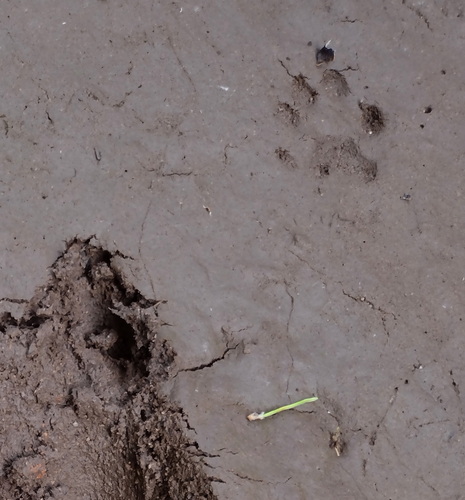
Stone Marten tracks show 5 toes, though often only 4 are visible. They are 3-4 cm long, with visible claw marks. When trotting, they form a characteristic mustelid double-track pattern, with tracks appearing in pairs.
Droppings are elongated and twisted, 6-10 cm long. They contain hair and bone fragments or fruit seeds, depending on
Rocky areas, rock faces, open woodland and, above all, humanised environments such as villages, farms, and urban peripheries, from lowlands to mid-mountain areas. It is distributed throughout much of Europe and Central Asia, showing remarkable adaptability to landscapes greatly transformed by humans.
Opportunistic omnivore, it feeds on small mammals, birds, eggs, fruit, and insects, also making use of remains and waste in areas near human settlements.
Solitary and mainly nocturnal, with a home range that can overlap extensively with human-inhabited areas.
It exhibits delayed implantation. Mating occurs in summer, but the embryo does not implant in the uterus until winter. Actual foetal development therefore lasts only a few weeks, even though total gestation extends for several months.
The Stone Marten maintains large, generally stable or expanding populations throughout most of its range, favoured by its adaptability to human-modified environments, with no signs of widespread decline.
Roadkill, especially in peri-urban areas where the Stone Marten is most abundant, and occasional persecution due to damage it causes by gnawing vehicle cables and occasional predation of poultry.
See all species accounts for carnivores · Full species index
Mammaling is a free app for logging the mammals you find. You record a sighting in a moment — even if it's just a track — your life list grows, and the record becomes available to scientific and conservation projects.
It runs on your phone with nothing to install. If you like, it adds to your home screen like any other app.
Open Mammaling