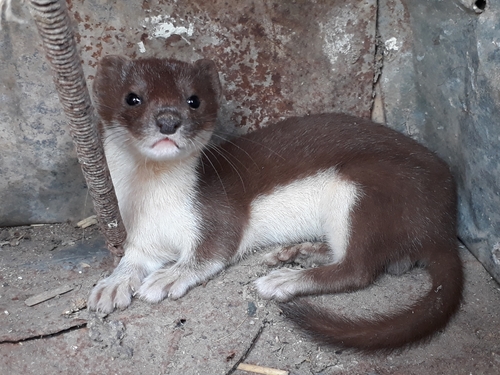
It is the smallest carnivore on the planet. So slender and elongated, it can slip through the same tunnels excavated by Voles, its favourite prey, and hunt them within their own burrows.
In populations in northern Europe and cold areas of Asia, its fur turns white in winter. In the rest of its range, it retains the same brown colouring all year.
Despite its tiny size,
The world's smallest mustelid, with a very elongated, slender body. Its fur is reddish-brown on the back and pure white on the belly, with a straight line separating the two colours. It can be confused with the Stoat, but the Stoat is larger, always has a black tail tip (absent in the Least Weasel), and the line between its dorsal and ventral colouring is usually wavy.
Tiny track, 1.5-2 cm long, with 5 indistinct toes. Difficult to find except in snow or fine mud, where it leaves a trail of very close paired bounds.
Very fine and twisted droppings, 3-5 cm long, containing hair and small bone fragments, deposited scattered near rodent burrows. The Least Weasel hunts inside the burrows of its prey, so it rarely leaves visible digging marks on the surface. It is sometimes detected by a sharp whistle or short growl when it feels threatened.
Highly varied: woodland, hedgerow, grassland, agricultural land and rocky areas, wherever rodents are abundant. Distributed throughout almost all of Europe, Asia and North Africa, and introduced to New Zealand; from sea level up to mid-mountain areas.
A carnivore specialising in small rodents, especially voles, which it pursues inside their own burrows. It also occasionally hunts small birds and eggs.
Solitary and highly territorial, with a small home range linked to prey availability. In populations in northern Europe and cold areas of Asia, the coat moults to white in winter, while in most of temperate Europe it retains its brown coat all year. It does not exhibit delayed implantation, unlike the Stoat, so gestation is short and direct.
Least Weasel maintains widespread populations throughout most of its range, though these are closely linked to rodent abundance cycles, with significant year-to-year fluctuations.
Rodenticide use, reducing prey and causing secondary poisoning; loss of hedgerows and traditional agricultural habitat; and roadkill.
See all species accounts for carnivores · Full species index
Mammaling is a free app for logging the mammals you find. You record a sighting in a moment — even if it's just a track — your life list grows, and the record becomes available to scientific and conservation projects.
It runs on your phone with nothing to install. If you like, it adds to your home screen like any other app.
Open Mammaling