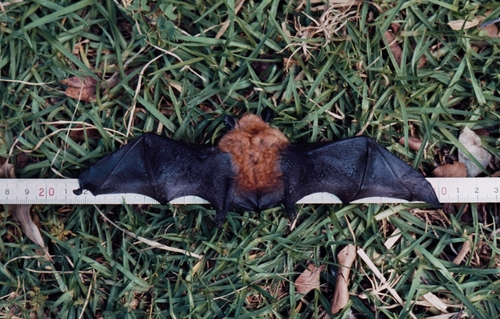
With strikingly reddish fur, very distinct from the dull brown of most African Myotis species, the Bocage's Myotis lives in damp and dry savannas across much of sub-Saharan Africa. It frequently roosts in human structures and tree holes, forming small groups that rarely exceed ten individuals.
A small bat with striking reddish to orange fur on its back and a paler belly. Ears are moderate in size. It differs from other Myotis species in the region by this very characteristic reddish tone, which is unusual for the genus.
There are no reliably published data on the echolocation call frequency specific to this species, so no concrete figures are given here. Roosts are the most accessible tracks and signs: it occupies tree holes, rock crevices and buildings in small groups, leaving accumulations of dark guano beneath the perch.
Damp and dry savanna, from sea level up to mid-altitude zones, across a broad mosaic of sub-Saharan Africa.
Nocturnal flying insects.
Forms small groups of up to around ten individuals in roosts ranging from tree holes to human structures.
The species maintains a large and stable population across most of its range, with no evidence of widespread decline.
No widespread threats identified.
See all species accounts for bats · Full species index
Mammaling is a free app for logging the mammals you find. You record a sighting in a moment — even if it's just a track — your life list grows, and the record becomes available to scientific and conservation projects.
It runs on your phone with nothing to install. If you like, it adds to your home screen like any other app.
Open Mammaling