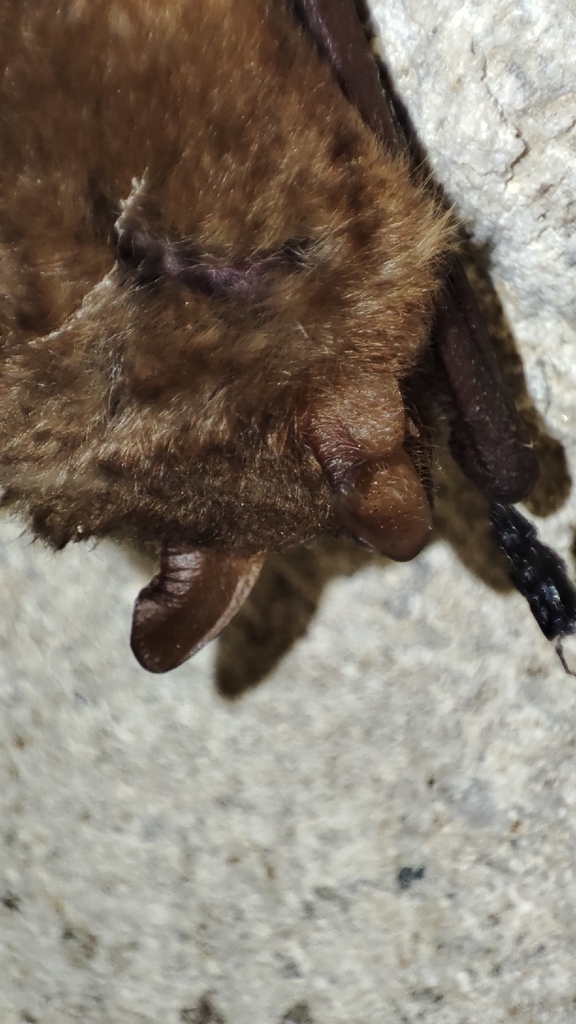
It has a very characteristic notch on the edge of the ear, the feature that gives the species its name, a minute detail that proves to be one of the most reliable features for identifying it in the hand among the many similar-looking Myotis species living in Europe. It is an almost exclusive specialist on spiders—an uncommon feeding habit among European bats—which it gleans directly from webs and from rock or bark crevices, flying very slowly and with great control close to the surface. It forms maternity colonies, often mixed with other cave-dwelling species, in caves, mines and lofts in temperate climates, making it a good indicator of the conservation status of underground roosts shared by several bat species simultaneously.
A small- to medium-sized bat with reddish-brown fur on the back and light grey on the belly, showing a notable color contrast between the two, and a characteristic notch on the outer edge of the ear that gives it its name. It differs from other Myotis of similar size precisely by this ear notch, a reliable diagnostic feature in the hand that no other European Myotis displays with the same clarity.
Peak frequency between 47 and 58 kHz. Broadband FM-type pulse with a pronounced sweep, visible on the detector as a short, curved trace. Duration from 2 to 4 milliseconds. It is difficult to separate with certainty from other broadband Myotis by the sonogram alone, although its characteristic very slow flight close to vegetation, almost brushing leaves and branches while picking spiders from their webs, helps guide field identification without fully guaranteeing it. Under feeding perches, remnants of torn spiderweb can be found alongside small, fibrous droppings; in cave or loft roosts it often shares the same heap of droppings with other cave-dwelling species, making it difficult to attribute the tracks and signs to this species in particular; it emerges relatively late after sunset.
Areas of dense vegetation, orchards, gardens and woodland edges for hunting, roosting in caves, mines, lofts and tree holes, from lowlands up to mid-mountain zones. Distributed across southern and central Europe, North Africa and parts of western Asia.
An insectivore specialising in spiders, supplemented with flies and other slow-flying insects, gleaned directly from webs, leaves and crevices by means of very slow, manoeuvrable flight.
Forms maternity colonies, often mixed with other cave-dwelling species, in caves, mines and lofts, showing a remarkable tolerance for sharing roosts with different species. Its slow flight and specialization on slow-moving prey such as spiders distinguish it from the more active hunting behaviour of other Myotis.
Its populations are generally considered stable across most of its range, although locally sensitive to the loss and alteration of underground and loft roosts shared with other cave-dwelling species.
Alteration and closure of caves, mines and lofts used as maternity roosts, human disturbance in mixed colonies, and loss of areas of dense vegetation where it hunts due to agricultural intensification.
See all species accounts for bats · Full species index
Mammaling is a free app for logging the mammals you find. You record a sighting in a moment — even if it's just a track — your life list grows, and the record becomes available to scientific and conservation projects.
It runs on your phone with nothing to install. If you like, it adds to your home screen like any other app.
Open Mammaling