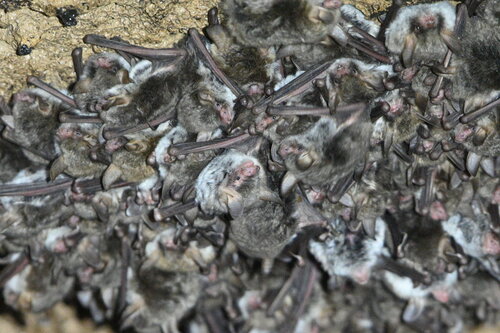
Escalera's Myotis is the Iberian form of a trio of sibling bats that only genetic analysis has been able to distinguish. For over a century, they were all studied as a single species under the name Natterer's Bat. It flies slowly and with great control among branches and shrubs, almost fluttering. This hunting style allows it to catch insects perched on surfaces where a faster bat could never manoeuvre. Its name honours the Spanish naturalist who first drew attention to the subtle differences of this population, long before science could confirm he was right.
Escalera's Myotis is a small to medium-sized bat with greyish-brown fur, a whitish belly, and a characteristic fringe of stiff, curved hairs along the edge of its uropatagium. It is externally indistinguishable from Myotis crypticus and very similar to Myotis nattereri. Only genetic analysis can reliably confirm the species, as the three taxa share almost all their external and cranial morphology.
Peak energy frequency between 35 and 90 kHz, concentrated mainly between 45 and 55 kHz. Broadband FM pulse with a very pronounced, short sweep, visible on the detector as an almost vertical trace. Duration 2-5 milliseconds, in denser bursts when hunting near vegetation. Cannot be reliably separated from Myotis crypticus or Myotis nattereri by sonogram. The three taxa in the complex have an essentially identical acoustic pattern, and any species identification based solely on sound should be considered provisional. Beneath feeding perches, cut prey remains and discarded moth wings may be found, along with scattered small guano. Escalera's Myotis emerges late in twilight, later than other species that hunt in more open areas.
Deciduous, mixed, and riparian forest with well-developed undergrowth, from lowlands to mid-mountain areas. Distributed across the Iberian Peninsula and southwest France, representing the western form of the former Natterer's complex.
Insectivorous and slow-flying, it catches moths, dipterans and spiders both in flight and by gleaning them directly from vegetation.
It forms small breeding colonies in tree hollows, rock crevices, bridges and bat boxes, changing roosts quite frequently within its home range. Its slow, highly manoeuvrable flight allows it to exploit dense vegetation largely inaccessible to other species.
Its status has been reclassified as of greater concern in recent assessments, with indications of decline linked to the loss of mature woodland with available hollows. It had previously been assessed as lower risk, when it was not yet clearly distinguished from its sibling species.
Loss of mature forest with old, hollow trees available for roosting, intensive forest management, and reduction of insect prey due to pesticide use in agricultural areas near the forest.
See all species accounts for bats · Full species index
Mammaling is a free app for logging the mammals you find. You record a sighting in a moment — even if it's just a track — your life list grows, and the record becomes available to scientific and conservation projects.
It runs on your phone with nothing to install. If you like, it adds to your home screen like any other app.
Open Mammaling