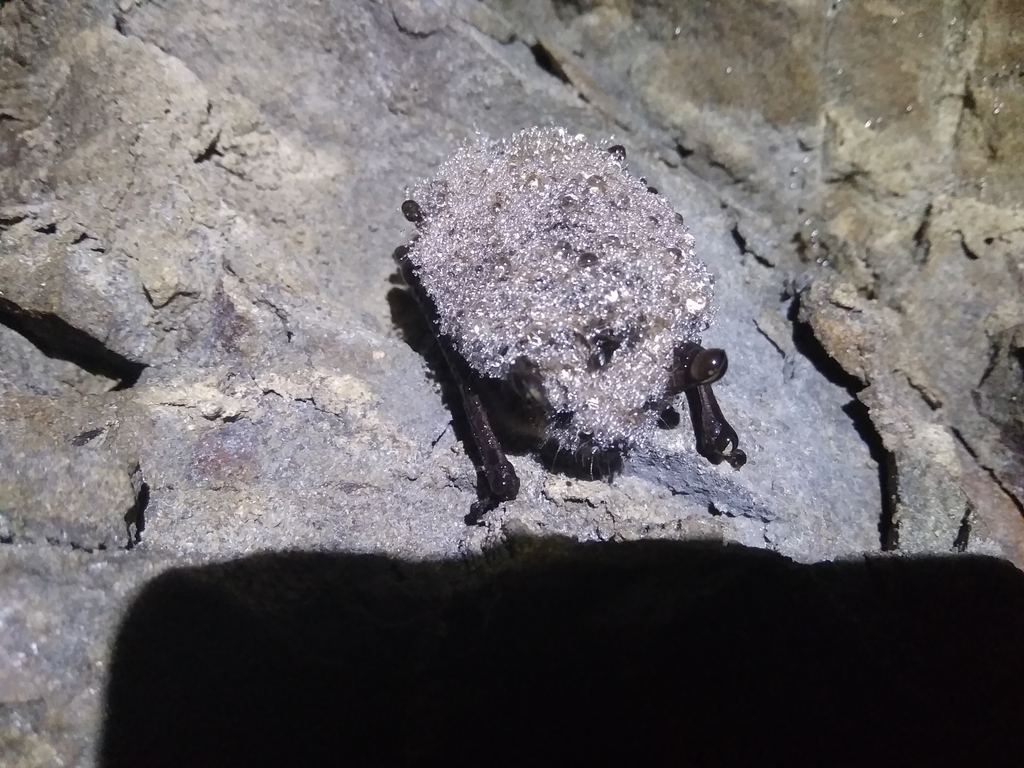
It owes its name to the fine, long hairs surrounding its snout like a tiny moustache. While easily overlooked at first glance, this detail forms part of a suite of features used to distinguish it from its closest relatives. It is one of the smallest and most agile bats in Europe, capable of hunting in slow, highly manoeuvrable flight along hedges, woodland rides and tree-lined streets in villages and small towns—a much more varied habitat than that used by other, more specialised bats. It belongs to a group of three or four species of almost identical appearance, a taxonomic puzzle that only genetic analysis has fully resolved over the last two decades.
A small bat with dark brown, almost black fur in some individuals, long fine hairs around the snout that give the species its name, medium-sized ears and a pointed tragus. In the hand, it is virtually indistinguishable from Brandt's Bat and Alcathoe Bat. Together they form a cryptic species complex whose reliable separation almost always requires genetic analysis or very precise measurements of the male penis.
Frequency of maximum energy between 45 and 50 kHz. Broadband FM pulse with a steep sweep, appearing on the detector as a short, almost vertical trace similar to that of other small Myotis species. Duration 2 to 4 milliseconds. It cannot be reliably separated from Brandt's Bat or Alcathoe Bat from the sonogram: all three species share a virtually identical acoustic pattern, and the exact species should not be confirmed by sound alone in this group. Small prey remains and scattered, tiny, fibrous droppings can be found beneath feeding perches in hedges and tree-lined edges. It emerges relatively early, shortly after sunset.
Hedges, woodland rides, orchards and wooded areas in villages and small towns, from lowlands up to mid-altitude mountain areas. Distributed across much of Europe, extending into western Asia.
Insectivorous, hunting small flying insects and spiders close to hedges, edges and wooded vegetation using a slow, highly manoeuvrable flight.
Forms small breeding colonies in tree holes, building crevices and bat boxes, showing good tolerance of rural and peri-urban environments with wooded vegetation. Its slow, manoeuvrable flight allows it to exploit dense vegetation uncluttered enough to be inaccessible to faster-flying species.
Its populations are generally considered stable across most of its range, with no evidence of widespread decline, partly thanks to its good tolerance of rural and peri-urban landscapes with wooded vegetation.
Loss of hedges and tree-lined edges in intensified agricultural landscapes, insecticide use reducing prey availability, and the loss of mature tree hollows available for roosting.
See all species accounts for bats · Full species index
Mammaling is a free app for logging the mammals you find. You record a sighting in a moment — even if it's just a track — your life list grows, and the record becomes available to scientific and conservation projects.
It runs on your phone with nothing to install. If you like, it adds to your home screen like any other app.
Open Mammaling